
Robotics
GENE.01
Generative Bionics' humanoid robot, fusing touch, force, and vision on board rather than in a data center
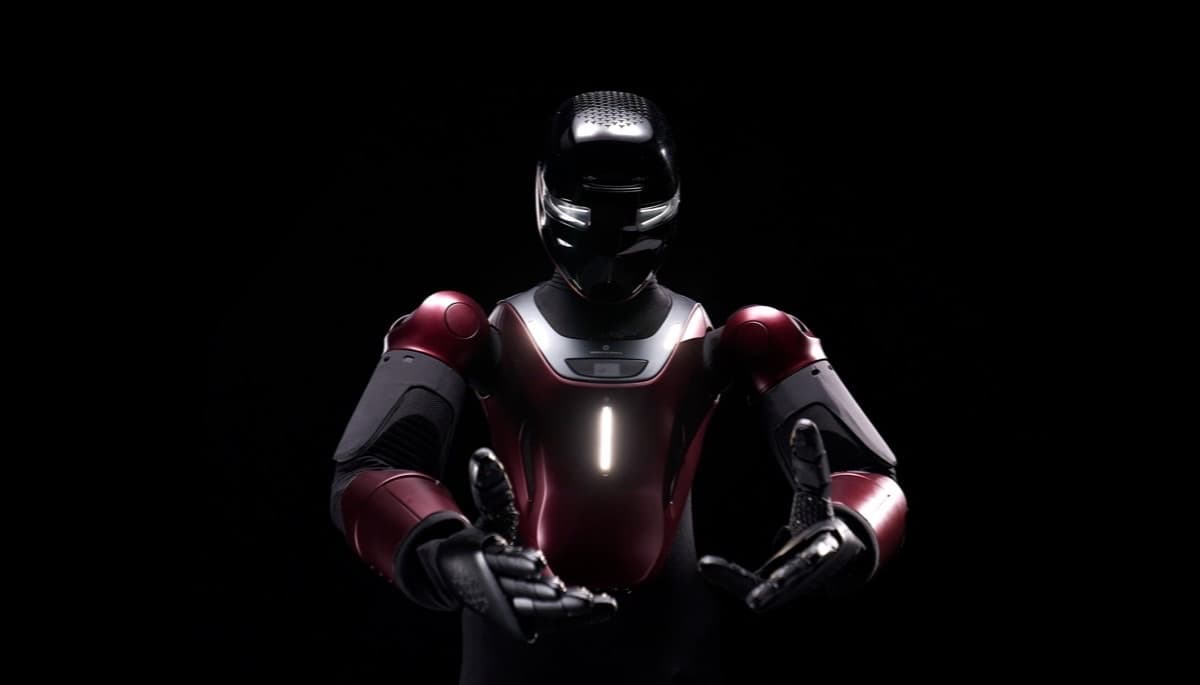
Generative Bionics is a deep-tech company in Genoa building humanoid robot platforms for what it calls human-centered Physical AI: robots meant to work next to people every day, on factory floors and in shipyards, as labor shortages widen. GENE.01 is its first, unveiled in July 2026 after roughly six months from concept to a working platform. QVAC runs the intelligence on board, because a robot in contact with a person cannot afford to ask a data center what to do next.
Touch as a source of intelligence
GENE.01 is wrapped in a full-body distributed tactile skin that reads touch, temperature, proximity, and force, so it can register a person approaching before contact and keep reading the contact while it happens. Those tactile and force signals are fused with vision at high frequency, which is what turns interaction into a control input rather than a safety interlock bolted on afterwards. That fusion loop is the part that has to be local: the latency budget between feeling a hand and reacting to it is measured in milliseconds.
Body as compute
Generative Bionics designs the body, the mechanics, and the motion intelligence as one system rather than fitting a controller to finished hardware, tuning both together against measurable targets like ergonomics and walking stability. The on-board compute stack, built with AMD, spans CPUs, GPUs, FPGAs, and embedded processors to carry that fusion in real time. Actuation comes from a partnership with Synapticon on an EU-sovereign stack, and the company's $81M seed round was led by CDP Venture Capital with AMD Ventures, Duferco, Eni Next, RoboIT, and Tether participating.
An open platform, headed for the shipyard
GENE.01 is published as an open platform: its open libraries are meant to let one robot specialize into deployable configurations across factories and healthcare, and the URDF model is already public at github.com/gbionics/gb-robot-models. The first task-specific configuration is a welding humanoid for complex shipyard environments, built with Fincantieri.
See it move
Why the intelligence rides on the robot
MORE FROM THE SHOWCASE
Build this
Ship your own local AI
One install in JavaScript or Python. 10+ AI tasks. Private, offline and free - on the hardware you already own.