

Fast inference demands C++, but rapid development favours a scripting language. For shipping products, JavaScript is hard to beat.
Most JS runtimes, however, carry baggage (a browser-grade engine, a large standard library, platform-specific quirks, …) and that overhead matters when embedding an AI module on a mobile device or a resource-constrained edge node. Bare by Pears is a minimal JS runtime designed to deliver exactly this: a small, embeddable engine with first-class native addon support, running on all major platforms.
In this post, we will walk you through the full process of building a C++ AI add-on for Bare, from CMake configuration to JavaScript API, using a simple binary classifier as our running example.
Once the plumbing is in place, you can swap in any engine: a deep neural network, a transformer, or an existing AI engine. Production add-ons built on QVAC already use this pattern for state-of-the-art LLM inference, enabling on-device fully offline AI that keeps your data private.
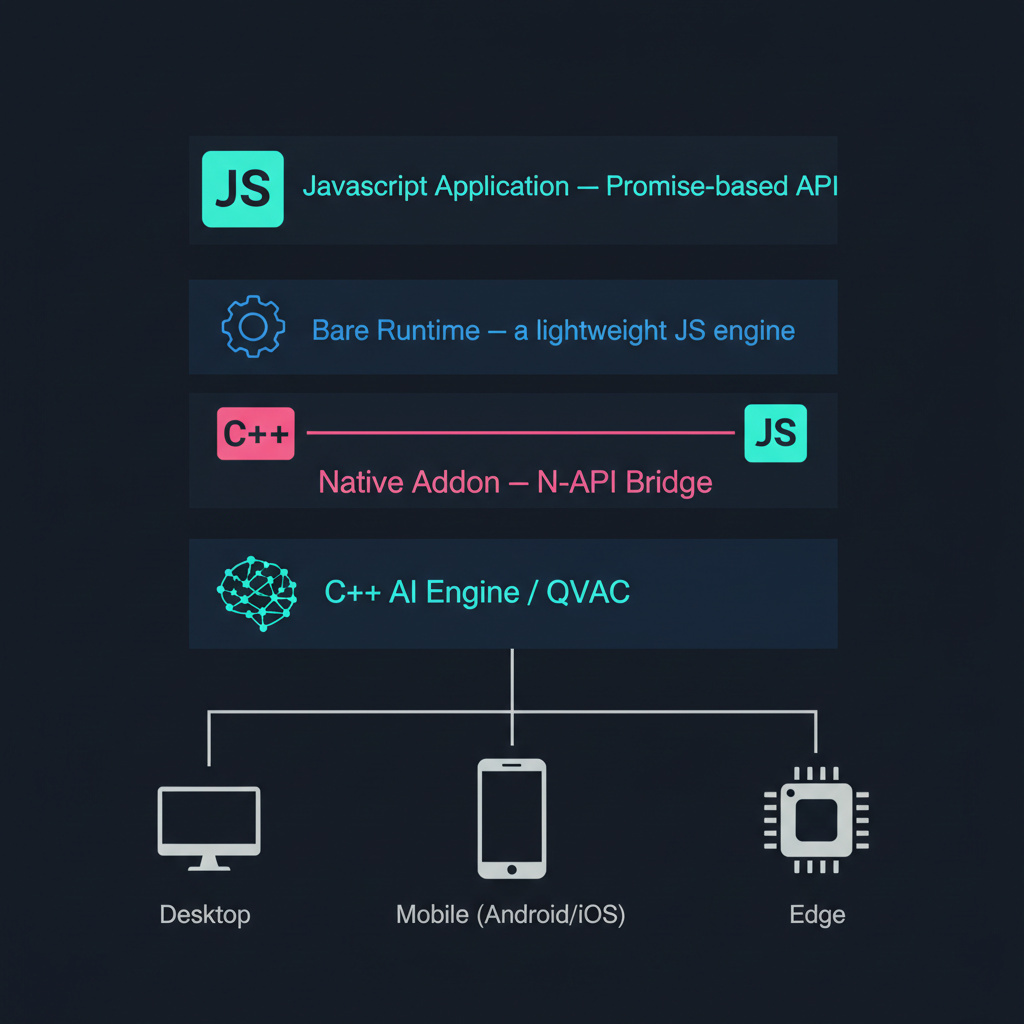
Anatomy of a Bare add-on
A Bare addon is a shared library (.so, .dylib or .dll) that the runtime loads at require.addon() time. The C++ side exports functions that JavaScript can call, and communication flows through the Bare N-API compatible C interface (js_env_t, js_value_t, etc.): opaque types that represent the JS execution environment and JS values on the C++ side.
For an AI add-on, three operations form the minimal surface area:
| Function | Purpose |
createInstance | Allocate the model, wire up the callback pipeline |
runJob | Submit input for inference (non-blocking) |
destroyInstance | Free memory, tear down threads |
A fourth operation (train) is specific to our example: it trains the logistic regression model and returns the learned weights. In a production add-on backed by a large model you would load pre-trained weights instead.
Setting up the build
Bare uses CMake as its build system. The cmake-bare package provides the add_bare_module helper that handles compiler flags, output naming and platform quirks:
find_package(cmake-bare REQUIRED PATHS node_modules/cmake-bare)
find_package(cmake-vcpkg REQUIRED PATHS node_modules/cmake-vcpkg)

project(classifier-addon C CXX)

add_bare_module(classifier-addon)
target_sources(${classifier-addon} PRIVATE addon/binding.cpp) # variable set by add_bare_module

# ...
cmake-vcpkg integrates vcpkg, so C++ dependencies are fetched automatically. You declare them in a vcpkg.json manifest at the project root. See our manifest for example: the only entry is qvac-lib-inference-addon-cpp, which provides the add-on framework we use to avoid writing boilerplate.
Below is binding.cpp the file Bare loads. Each V(name, fn) macro registers a C++ function under a JS-visible name:
#include <bare.h>
#include "AddonJs.hpp"

js_value_t*
classifierAddonExports(js_env_t* env, js_value_t* exports) {

#define V(name, fn)                                                  \
  {                                                                  \
    js_value_t* val;                                                 \
    if (js_create_function(env, name, -1, fn, nullptr, &val) != 0) { \
      return nullptr;                                                \
    }                                                                \
    if (js_set_named_property(env, exports, name, val) != 0) {       \
      return nullptr;                                                \
    }                                                                \
  }

  V("createInstance", classifier_addon::createInstance)
  V("runJob", classifier_addon::runJob)
  V("train", classifier_addon::train)
  V("destroyInstance",
    qvac_lib_inference_addon_cpp::JsInterface::destroyInstance)

#undef V
  return exports;
}

BARE_MODULE(classifier_addon, classifierAddonExports)
Notice that destroyInstance is bound directly from the library no custom code needed. We only write the functions that are specific to our model.
These exported functions can be used from JavaScript by importing the add-on:
const binding = require.addon()

// Example usage
const handle = binding.createInstance(this, new Float64Array(weights), onOutputCb)
binding.runJob(handle, new Float64Array(features))
binding.train(xArrays, yArray)
binding.destroyInstance(handle)
Reducing Boilerplate with addon-cpp
Writing a native add-on from scratch means dealing with a lot of repetitive plumbing: instance tracking, thread-safe reference counting, JS type marshalling, error propagation across the C++/JS boundary, and output callback wiring. The inference-addon-cpp library handles all of this, so you can focus on your model.
JsInterface is the main component: it contains a registry of model instances and provides a set of ready-to-bind functions (e.g. JsInterface::destroyInstance) that work with C++ models composed into the AddonJs class.
With the library in place, your addon-specific code reduces to:
- A model class implementing
IModel(justgetName(),process()andruntimeStats()) createInstancefunction that parses config, constructs the model, and composes it into anAddonJs- A
runJobfunction that parses input and forwards it toIModel::process - Any custom methods (like
trainin our example)
Everything else (destroyInstance, instance tracking, thread management, JS ↔ C++ error handling) is taken care of.
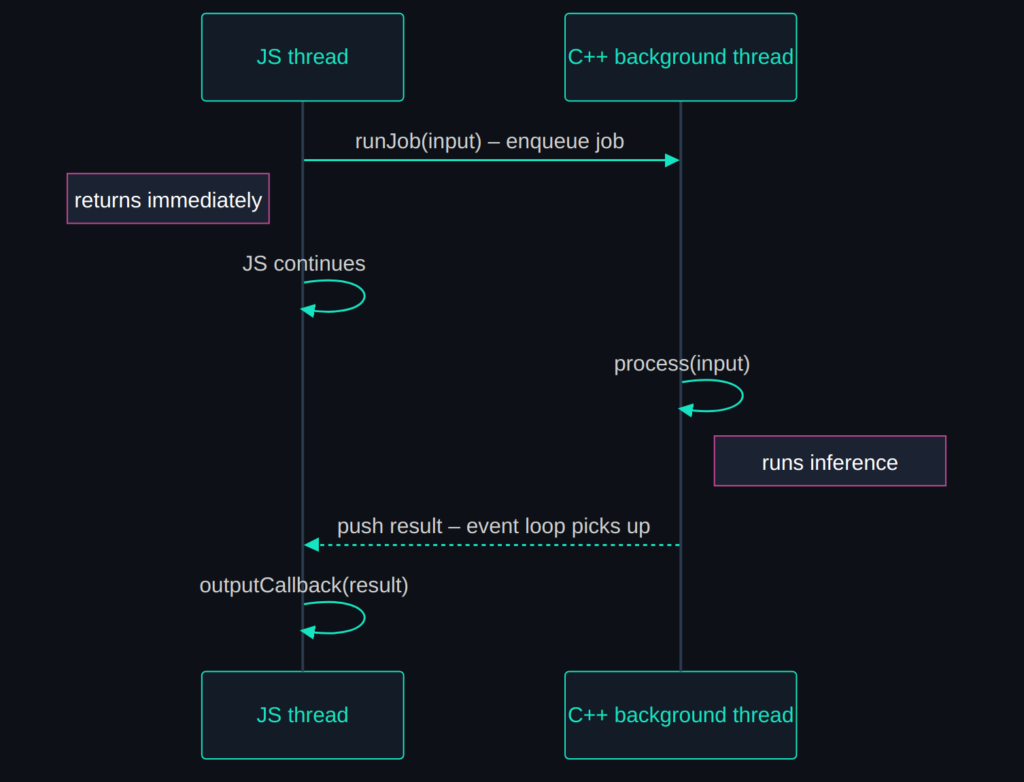
The AddonCpp engine: non-blocking inference
The key design point: runJob returns immediately with a boolean indicating whether the job was accepted. The model runs on a dedicated background thread. When it finishes, the result is pushed to an output queue where it can be picked up by the JS event loop. This means the JS thread is never blocked, even for expensive inference.
The core of our C++ implementation is the LogisticRegression class, which implements the IModel interface. It needs two main pieces: a constructor that receives the model weights, and a process function that runs inference.
process takes and returns std::any, so each addon defines its own input/output types without touching the framework: you cast to whatever C++ type your model expects and return the result the same way. This keeps the interface open for complex models that handle multiple input/output types through a single bridge point, and pairs naturally with JS’s dynamic typing on the other side of the boundary.
The model itself is a single class implementing IModel:
class LogisticRegression : public qvac_lib_inference_addon_cpp::model::IModel {
  std::vector<double> params_;

public:
  explicit LogisticRegression(std::vector<double> params)
      : params_(std::move(params)) {}

  std::any process(const std::any &input) override {
    const auto &features = std::any_cast<const std::vector<double> &>(input);

    // ... normalize features using stored mean/stddev, compute sigmoid ...

    return sigmoid(z); // probability as double
  }

  static std::vector<double> train(const std::vector<std::vector<double>> &X,
                                   const std::vector<double> &y,
                                   int maxIter = 1000, double lr = 0.1) {
    // Gradient descent — returns [bias, w1, ..., wd, mu1, ..., mud, sd1, ..., sdd]
    // ... implementation details ...
  }
};
When writing our bridge functions (C++ to JS), JsArgsParser handles argument extraction and type casting from the JS call, throwing meaningful errors in misuse. In addition, js::TypedArray<T>().as<>() converts JS typed arrays into C++ containers.
Every bridge function is wrapped in a try { ... } JSCATCH block. JSCATCH is a macro that catches any C++ exception thrown during execution (whether it’s from JsArgsParser validation, a failed type cast, or an error inside process()) and converts it into a JavaScript exception via Bare’s libjs C API (bare.h / js_*). This means a throw std::runtime_error("bad input") on the C++ side surfaces as a regular JS error that you can catch with try/catch or handle through Promise rejection, rather than crashing the process.
For example:
args.get(0, "jsHandle")           // grabs the first positional argument
args.get(1, "weights")            // grabs the second argument (e.g. a Float64Array)
args.getFunction(2, "outputCallback") // grabs the third argument, asserting it is a function
To implement createInstance, we parse the arguments from binding.createInstance(jsHandle, Float64Array, outputCallback):
inline js_value_t *createInstance(js_env_t *env, js_callback_info_t *info) try {
  using namespace qvac_lib_inference_addon_cpp;

  JsArgsParser args(env, info);

  auto weights = js::TypedArray<double>(env, args.get(1, "weights"))
                     .as<std::vector<double>>(env);
We then create the model and wire up output handlers, which route and convert the return types of process() to the JS callback:
  auto model = std::make_unique<LogisticRegression>(std::move(weights));

  // Register output handlers (double handler for probability)
  out_handl::OutputHandlers<out_handl::JsOutputHandlerInterface> outHandlers;
  outHandlers.add(std::make_shared<JsDoubleOutputHandler>());

  // Create the callback pipeline
  auto callback = std::make_unique<OutputCallBackJs>(
      env, args.get(0, "jsHandle"), args.getFunction(2, "outputCallback"),
      std::move(outHandlers));
Users of the library have the flexibility to implement custom handlers. The library provides built-in handlers for common types (JsStringOutputHandler, JsTypedArrayOutputHandler, etc.). For our case we defined a simple JsDoubleOutputHandler that converts std::any(double) to a JS number.
Finally we wrap the model in an AddonJs instance and register it with JsInterface:
  // Bundle model + callback into AddonJs and register it
  auto addon =
      std::make_unique<AddonJs>(env, std::move(callback), std::move(model));

  return JsInterface::createInstance(env, std::move(addon));
}
JSCATCH
The runJob bridge retrieves the registered instance and forwards the input. It follows the same argument-parsing pattern as createInstance:
inline js_value_t *runJob(js_env_t *env, js_callback_info_t *info) try {
  using namespace qvac_lib_inference_addon_cpp;

  JsArgsParser args(env, info);
  auto &instance = JsInterface::getInstance(env, args.get(0, "instance"));

  auto features = js::TypedArray<double>(env, args.get(1, "features"))
                      .as<std::vector<double>>(env);

  return instance.runJob(std::any(std::move(features)));
}
JSCATCH
The train bridge follows the same argument-parsing pattern but doesn’t need to retrieve an instance: it calls LogisticRegression::train directly and returns the weights as a typed array.
TIP: Accessing your concrete model from a bridge function
Custom methods that need the model instance can retrieve it from JsInterface and downcast to the concrete type:
auto &model = dynamic_cast<LogisticRegression&>(*instance.addonCpp->model);
model.someCustomMethod();
This gives you direct access to any method beyond the IModel interface — useful for diagnostics, configuration changes, or domain-specific operations that don’t fit the generic process() path.
The Javascript Wrapper
On the JS side we wrap the raw binding in a ClassifierInterface class that provides a Promise-based API:
constructor(params)callsbinding.createInstance, stores the handle and binds the output callbackpredict(features)returns a Promise, callsbinding.runJobunder the hood`static train(X, y)`calls`binding.train`directly and returns the learned weightsdestroy()`calls `binding.destroyInstance`to free the native instance
The callback passed to `createInstance` receives four arguments:
- addon: the JS `
this` handle - event a type string identifying the output kind
- data the output payload (a number for predictions, an object for runtime stats)
- error an error string when something goes wrong
The `_onOutput` method in `addon.js` handles this routing checking for errors, stashing the output and settling on the final runtime-stats event:
_onOutput (addon, event, data, error) {
  if (typeof error === 'string') {
    return this._settle(null, new Error(error))
  }

  if (typeof data === 'number') {
    this._result = data
  } else if (typeof data === 'object' && data !== null) {
    this._settle(this._result)
  }
}
The Promise wiring is straightforward: `predict` stashes the `resolve`/`reject` callbacks, and `_settle` fires whichever one applies when the native side delivers a result. Because `runJob` is non-blocking and the C++ side runs on its own thread, concurrent `predict()` calls would race on the shared `_resolve`/`_reject` state. We serialize access with a `_run` critical section based on `exclusiveRunQueue` (a Promise-based queue that ensures only one job is in flight at a time):
predict (features) {
  return this._run(() => {
    return new Promise((resolve, reject) => {
      this._resolve = resolve
      this._reject = reject
      const accepted = binding.runJob(this._handle, new Float64Array(features))
      // ... reject immediately if not accepted ...
    })
  })
}

_settle (value, error) {
  const { _resolve: resolve, _reject: reject } = this
  this._resolve = null
  this._reject = null
  if (error) { if (reject) reject(error) } else { if (resolve) resolve(value) }
}
The callback is invoked twice per prediction. First, with `data` as a number (the probability returned by `process()`), which we stash directly. Then, with `data` as an object (runtime stats), signaling the job is complete, at which point we resolve the Promise. If `process()` throws, the framework catches the exception and delivers it as the `error` argument, which `_settle` turns into a Promise rejection that surfaces when you `await classifier.predict()`.
This multi-event callback design is intentional: it makes the addon compatible with streaming models like LLMs, where `process()` fires the output callback incrementally (e.g. once per generated token) rather than returning a single result. The framework delivers each event separately, so `_onOutput` can accumulate partial results, update a UI, or stream tokens to a client as they arrive. Our classifier fires only two events (prediction + stats), but the same plumbing handles hundreds of incremental token events without any changes to the bridge or callback wiring.
If you set `DEBUG = true` in `addon.js`, you can see both calls logged. The first carries the prediction probability:
_onOutput { event: 'd', data: 0.999989, error: undefined }The second carries runtime stats and signals completion:
_onOutput { event: '...', data: { predict_count: 1 }, error: undefined }How to Compile and Run
Prerequisites:
- Bare runtime
CMake(`>= 3.25`)- A C++20 compiler (GCC 11+, Clang 14+ or MSVC 2022+)
vcpkg(handled automatically by `cmake-vcpkg`)bare-make(`npm install -g bare-make`)
Install dependencies and build:
npm install

npm run build
`bare-make` is the build tool for Bare addons. The build script runs three steps:
- generate (`
bare-make generate`) runsCMaketo produce the build files, fetchingvcpkgdependencies - build (
`bare-make build`) compiles the C++ code into a shared library - install (
`bare-make install`)copies the built addon to the correct location for`require.addon()`
Generate the dataset and run with Bare:
bare generate_synthetic_dataset.js

bare example.js
Expected output:
=== Binary Classifier Addon Example ===

Loading dataset: 50000 samples, 2 features (age, income)

Training logistic regression via native C++ addon (gradient descent, 1000 iterations)...

Training complete in <N>ms — learned 7 parameters

Creating classifier instance with trained weights...

Running predictions (non-blocking, executed on C++ background thread):

Student (age: 21, income: $12,000) → probability: 0.0000 → would NOT buy

Senior exec (age: 55, income: $130,000) → probability: 1.0000 → WOULD buy

Mid-career (age: 35, income: $55,000) → probability: 0.3587 → would NOT buy

Retiree (age: 65, income: $80,000) → probability: 0.3498 → would NOT buy

Destroying native instance (freeing C++ memory)...

Done.
The example loads synthetic `[age, income]` samples from `dataset.json`, trains logistic regression via gradient descent, and predicts whether four people would make a purchase. Predictions near the decision boundary (mid-career, retiree) show how the model handles ambiguous cases.
To measure the real-world benefit of a native addon, the repo includes a pure JavaScript implementation of the same logistic regression algorithm (`pure_js_example_comparison.js`). Both versions train on an identical dataset loaded from `dataset.json`.
hyperfine --warmup 2 'bare example.js' 'node pure_js_example_comparison.js'Results on Linux (Intel i5-12400F, 32 GB RAM):
Benchmark 1: bare example.js

Time (mean ± σ): 505.7 ms ± 15.3 ms [User: 478.2 ms, System: 36.3 ms]

Range (min … max): 491.8 ms … 543.9 ms 10 runs

Benchmark 2: node pure_js_example_comparison.js

Time (mean ± σ): 1.102 s ± 0.039 s [User: 1.099 s, System: 0.024 s]

Range (min … max): 1.060 s … 1.175 s 10 runs

Summary

bare example.js ran

2.18 ± 0.10 times faster than node pure_js_example_comparison.js
The pure JS version is a single, self-contained file that implements the same gradient-descent `train` and sigmoid `predict`: no native code, no build step. The ~2× gap is consistent in this setup, but exact speedups vary by hardware, dataset size, and runtime versions. In this example, the runtime difference between Bare and Node is comparatively small; most of the gap appears to come from native C++ computation versus interpreted code.
If you hit `ADDON_NOT_FOUND` the shared library isn’t where `require.addon()` expects it. Verify `bare-make install` succeeded and that `prebuilds/<platform>-<arch>/` contains the built file. When cross-compiling, double-check the `--platform` and `--arch` flags. If the build cache seems stale, delete `build/` and re-run `npm run build`. For other runtime issues see the Bare troubleshooting guide.
Compiling for Mobile
`bare-make` supports cross-compilation out of the box via the `--platform` and `--arch` flags. To build the addon for Android or iOS, point the generator at the target platform:
bare-make generate --platform android --arch arm64 # Android arm64

bare-make generate --platform ios --arch arm64 # iOS arm64 (device)
The built prebuilds land in `prebuilds/<platform>-<arch>/` and are picked up automatically by `require.addon()` at runtime.
Once the addon is compiled for mobile, you can embed Bare in a React Native or Expo application using react-native-bare-kit. The bare-expo repository provides a full working example of this setup: it shows how to start a Bare worklet inside an Expo app and communicate with it over IPC. For a working mobile integration that uses this pattern end-to-end, see the QVAC Workbench app.
Our classifier ships as a single shared library, but a production addon may need multiple — for example, GPU backends alongside a CPU fallback. The QVAC LLM addon shows how this works in practice: `add_bare_module` accepts extra `INSTALL TARGET` entries so each backend `.so`/`.dylib` is placed alongside the addon in `prebuilds/`, and the C++ side picks the right one at startup via `dlopen` (or the platform equivalent). On Android, the `.so` files end up in the APK’s native library directory so `dlopen("libbackend.so")` just works; on iOS, they are bundled as frameworks.
Conclusion
You now know how to build a native AI addon for the Bare JavaScript runtime. The pattern is:
- On the C++ side Implement `
IModel`: write`process()`for inference, optionally`train()`for training - Bridge by wiring the bindings: parse JS arguments, construct the model register output handlers
- For the JS side wrap in JS: expose a Promise-based API that your application code can consume
The full source code for this example is available at https://github.com/tetherto/qvac-bare-addon-example.
Bare and the QVAC ecosystem are open source and designed around minimal trust, maximal portability, and peer-to-peer operation without centralized infrastructure: contributions and new addons are welcome.
Check out the QVAC repo at github.com/tetherto/qvac. Try it. Break it. Tell us everything, complaints, and language pair requests on our community on Discord. Also, share with us if you’re building something where local AI plays a role – we’d love to hear about it!