
TL;DR
Nothing is more private than a thought. So when a model can decode speech directly from the brain, where it runs matters as much as how well it works. QVAC, Tether’s open-source on-device AI stack, now runs exactly that kind of model fully on the device, with nothing sent to a cloud. The model is BrainWhisperer, built by Tether Evo’s research team and now available in the QVAC SDK as a proof-of-concept capability. The version in the QVAC SDK is a small, end-to-end model: on real neural recordings it decodes more than 90% of words correctly for a single participant, an 8.7% word error rate, while running in under 2 GB of memory. A larger, more complex version of the same research placed 4th of 466 teams in an international challenge. It is early, but it puts a brain-to-text engine in developers’ hands, locally, as a foundation for the products that could one day give people their voice back.
QVAC and the model
QVAC’s newest and most experimental addition is a brain-computer interface (BCI): it can take neural signals and decode them into text, on-device, through a single SDK call.
The model behind that capability is BrainWhisperer, built by Tether Evo’s research team. It is integrated into the QVAC SDK at proof-of-concept level, and that is the important framing. It is not a product. It is a working engine that developers can run locally today, and a foundation for the assistive products that could be built on top of it tomorrow. The rest of this article is what it does, how well it does it, and why running it on-device is the whole point.
The hardest kind of silence
Imagine knowing exactly what you want to say and not being able to say it.
For people living with ALS and similar conditions, that is daily life. As the disease progresses, it takes control of the muscles: the arms, the hands, and eventually the face and the voice. Some can still try to form sounds, but the words come out unintelligible. Others cannot produce sound at all.
What does not change is the mind. The thoughts are still there. The language is still there. The person still composes full sentences, still has things to tell the people they love. The connection between the brain and the world is what breaks, not the brain itself. The result is a particular kind of isolation: present, aware, and unable to be heard.
For decades, the workarounds have been slow. Communication by tracking eye movements, letter by letter, is exhausting and error-prone. A full sentence can take minutes. That is the problem Tether Evo set out to change.
Reading the words from the source
Traditionally, people who cannot speak communicate through eye-tracking, choosing letters one at a time, which is slow and error-prone. BrainWhisperer goes straight to the source and reads the brain directly.
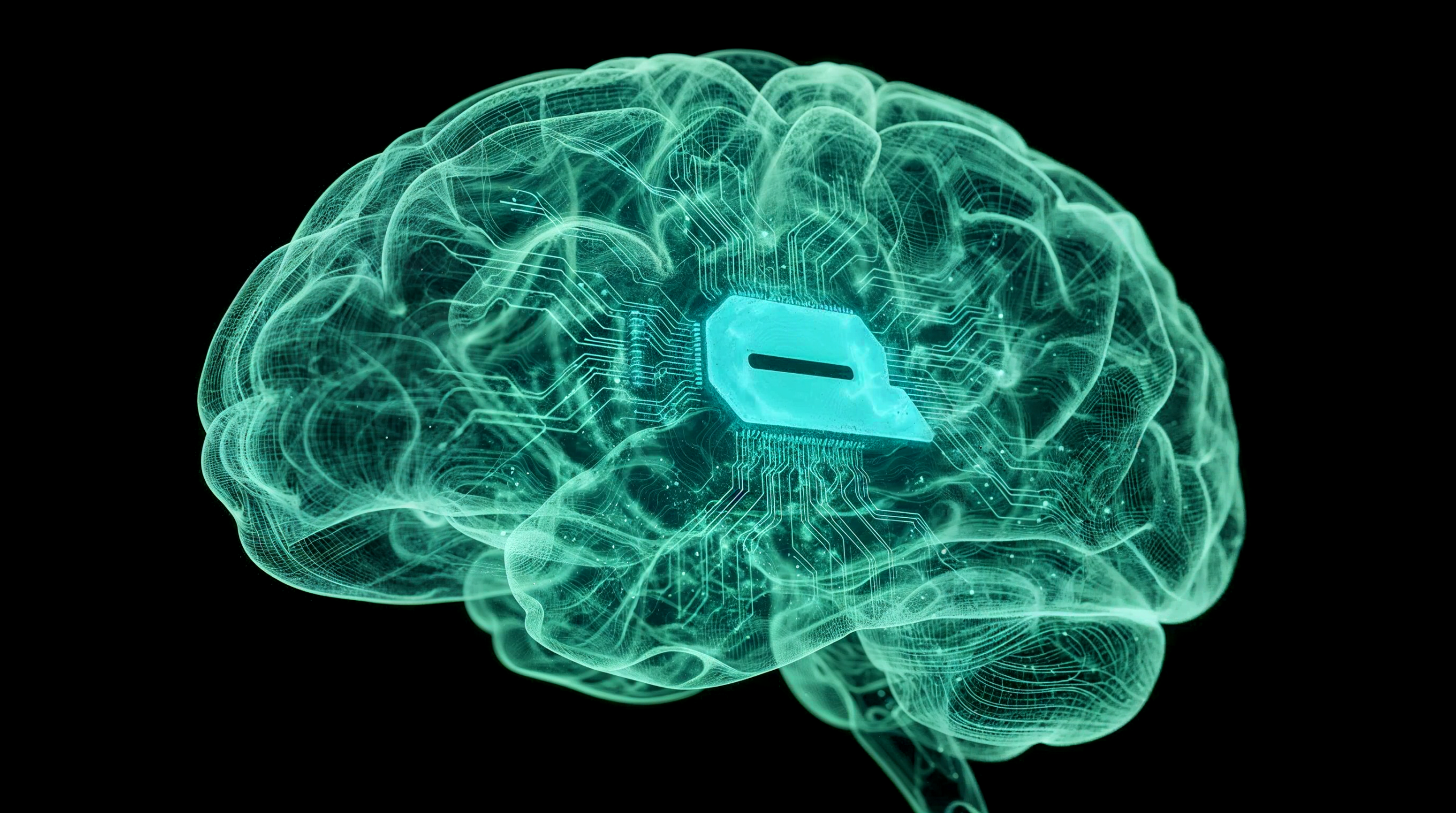
When a person tries to speak, a specific part of the brain, the speech motor cortex, lights up with electrical activity, the same way it would if the muscles were responding. A small implant placed there picks up that activity. BrainWhisperer takes those neural signals and translates them into text. You do not have to move your face. You think the words, and the model works as a translation layer, turning the language of the brain into English.
The clever part is where the model comes from. BrainWhisperer is a redesign of Whisper, the same family of speech-recognition AI that powers modern transcription, trained on hundreds of thousands of hours of human speech. Tether Evo rebuilt it to take neural data as input instead of audio. So instead of learning to turn sound into text from scratch, with the tiny amount of brain data that exists, it inherits everything a large speech model already knows about how language works, and applies it to the brain.
Once the words are decoded, they can go anywhere text can go: read aloud in a synthetic voice, or handed to an AI assistant to act on.
What the results actually show
This is the part that matters, because it is measured, not promised.
Tether Evo tested BrainWhisperer on real recordings from people implanted with a 256-channel array in the speech motor cortex, using a public research dataset, and then entered it into the Brain-to-Text ’25 challenge.
- It decoded a large majority of words correctly. On many sentences the transcription is exact, word for word: “i just bought a new house”, “do you believe in the dallas cowboys”, “that was the point”, all decoded perfectly.
- Measured as word error rate, the gold-standard accuracy metric, it reached single digits, and crossed below the 10 percent mark that researchers treat as the threshold for real-world usefulness. The paper reports this as the best end-to-end decoding ever achieved on that benchmark.
- A separate, more complex version of the model placed 4th out of 466 teams. It scores higher, but it is not end-to-end, so the SDK ships the smaller end-to-end model, which is the direction we want to build in.
- And it does this efficiently. The fast version runs in under 2 GB of memory with roughly 50 milliseconds of delay, compared to the hundreds of gigabytes of memory older approaches needed.
That last point is not a detail. It is the difference between a system that lives in a data center and one that can run on the device in front of the person.
Why local matters here more than anywhere
A thought is the most private thing a person has.
A speech decoder reads intention straight from the brain. If that has to travel to a server to be processed, you are sending the most intimate data a person has across a network. Because BrainWhisperer is light enough to run on a local device, the decoding can happen where the person is, with nothing leaving their hands. That is the role of QVAC, Tether’s open-source on-device AI stack: it is what lets a model like this run anywhere, privately, with no cloud in the loop.
The control stays with the person in another way too. The system only decodes speech the user is actively trying to produce. A person can simply choose not to, or think about something else, and there is nothing to read. Further ahead, ideas like “mental passwords” could ensure these systems always answer to their user and no one else.
Where this stands today, honestly
This is research, and it is important to be clear about that.
BrainWhisperer is a proof of concept, now available in the QVAC SDK as an experimental brain-computer-interface capability. It shows two things: that intended speech can be decoded from the brain accurately, and that it can run on ordinary local hardware thanks to QVAC. What it is not, yet, is a product you can use. What it is, is a working engine a developer can run locally today and build toward those products with.
The honest limits: the kind of brain implant this needs is rare, and getting one involves real medical, safety, and regulatory hurdles. The model has been trained on very few people, because very few people have these implants and only pre-recorded research data was available.The main model was trained on 4 participants; the smaller version in the SDK on a single one. It generalizes across the participants it has seen, which is itself a milestone, but a brand-new person would still need an implant and a short calibration period to record their own data before the model could adapt to them. There is real work between here and a usable system.
We would rather say that plainly than oversell it.
The frontier ahead
Today, the target is speech. But speech is one signal among many that the brain produces.
The same idea, reading the brain’s own activity and translating it into something we can share, points at a much wider horizon. The team sees a path toward decoding not just words, but the images a person pictures in their mind, the sounds they imagine, one day perhaps intended movement. We are not putting a date on any of it. It is the frontier we are walking toward, one careful result at a time.
A team at the edge of what is possible
BrainWhisperer comes out of Tether Evo, Tether’s research team working where technology, fundamental science, and medicine meet. Bringing their work into the QVAC SDK is what turns a research result into something a developer can run on a device today, and build the next assistive product on tomorrow. The thread is simple: use technology to make a life better, starting with the people who need it most.
Read the research: BrainWhisperer, arXiv 2603.13321.
FAQ
What is BrainWhisperer?
A research model that decodes intended speech directly from brain activity and turns it into text. It was built by Tether Evo on top of a large speech-recognition model adapted to read neural signals, and is now available in the QVAC SDK as a proof-of-concept capability.
Who is it for?
People who have lost the ability to speak, for example through ALS or severe paralysis, but whose ability to think and form language is intact.
How accurate is it?
On real neural recordings, the model in the QVAC SDK reaches an 8.7% word error rate for a single participant in an open vocabulary setting, so more than 90% of words are decoded correctly. A separate, more complex version placed 4th of 466 teams.; it scores higher but is not end-to-end, which is why the SDK ships the smaller end-to-end model.
Is my brain data sent to the cloud?
No. The model is small enough to run on a local device, so decoding can happen without sending neural data anywhere, and the system only reads speech the user is actively trying to produce.
Can I use it today?
As a developer, yes. The brain-to-text capability ships in the QVAC SDK as a proof of concept you can run and experiment with locally today. What it is not yet is a finished product for end users: real-world use by a patient still depends on a specialized brain implant, which carries significant medical and regulatory hurdles, plus a short per-person calibration.
Key takeaways
- BrainWhisperer reads intended speech from the brain and turns it into text, for people who cannot speak.
- It decodes more than 90% of words correctly for a single participant, an 8.7% word error rate. A separate, more complex version ranked 4th of 466 teams in an international challenge.
- It runs in under 2 GB on a local device, so the most private data a person has never has to leave their hands.
- It is research, not a product. The frontier ahead includes imagined images, sounds, and movement, with no fixed timeline.
BrainWhisperer is a research model from Tether Evo, now a proof-of-concept capability in the QVAC SDK. QVAC is Tether’s open-source on-device AI stack. Apache 2.0.