
Left out of a revolution
Tether is investing in AI inclusion for the hundreds of millions of people in Africa who are left behind today.
Hausa, Yoruba, Swahili, Amharic, Zulu. These languages are spoken by hundreds of millions of people, and in AI each of them is an afterthought. Open-source AI moved fast on the languages that already filled the internet, and left much of the world out of the revolution it started. The gap now limits AI access for over a billion people across the continent.
A second barrier sits on top of the first. Where language support does exist, it usually lives behind a cloud service, which needs a reliable connection and a payment method. Across much of Africa both are the exception. An AI that only works with good connectivity and a subscription is not available to the people who need it most.
Both halves have to be solved together. The model has to speak the language, and it has to run on a device someone already owns, offline, for free.
Translation is the door everything goes through
Translation is where QVAC and Tether have put real research money, for a straightforward reason. A medical explanation, a school course, a farming technique, a safety notice: none of them reach a person if they exist only in a language that person does not read.
Start with education. Across Africa, hundreds of millions of children and adults live where good schooling is scarce and reliable connectivity is scarcer still. A model that translates course material into a student’s own language, and runs on an inexpensive phone with no signal, turns a course into something they can actually take.
The same applies to agriculture and public information. Guidance on planting, disease, weather or safety exists in writing, usually not in the language of the person who needs it. On-device translation closes that distance without a data plan.
Health is the direction we are pushing hardest. We built QVAC MedPsy, a medical model small enough to run on a phone, to widen who can reach reliable health information. MedPsy works in English today. Bringing that information into African languages on the same device, with the safeguards medical use requires, is what we are building toward.
What we built
TranslatePsy-AfriSLM covers 19 African languages: Afrikaans, Amharic, Hausa, Igbo, Kinyarwanda, Lingala, Luganda, Malagasy, Nyanja, Oromo, Shona, Somali, Southern Sotho, Swahili, Tswana, Wolof, Xhosa, Yoruba and Zulu.
It comes in three sizes, 0.8B, 2B and 4B parameters, and we publish quantized GGUF builds alongside the full-precision weights. Those run through llama.cpp on a laptop or a smartphone, with no expensive GPU, no internet connection and no account.
The models hold multi-turn conversations, identify which language they are being addressed in, and switch between languages inside a single session. That is the difference between a translation tool and something a person can talk to.
The data problem
For a low-resource language, the instinct is to reach for a bigger model. The bottleneck here was the data.
African machine translation forces a choice between scale, coverage and quality. Large open datasets hold millions of sentence pairs but are full of duplication, imbalance and bad translations. Carefully curated sets are cleaner but cover fewer languages. Human-translated sets are excellent and far too small to train on alone.
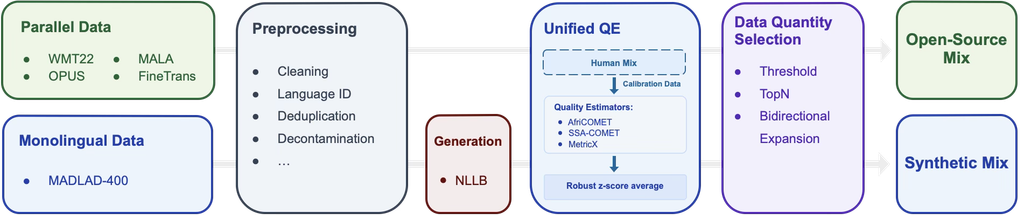
We stopped treating volume as the goal. Our pipeline scores every candidate sentence pair for translation quality, using three separate quality-estimation models combined into one score and calibrated against roughly 352,000 human-translated pairs, then keeps only the most useful training signal.
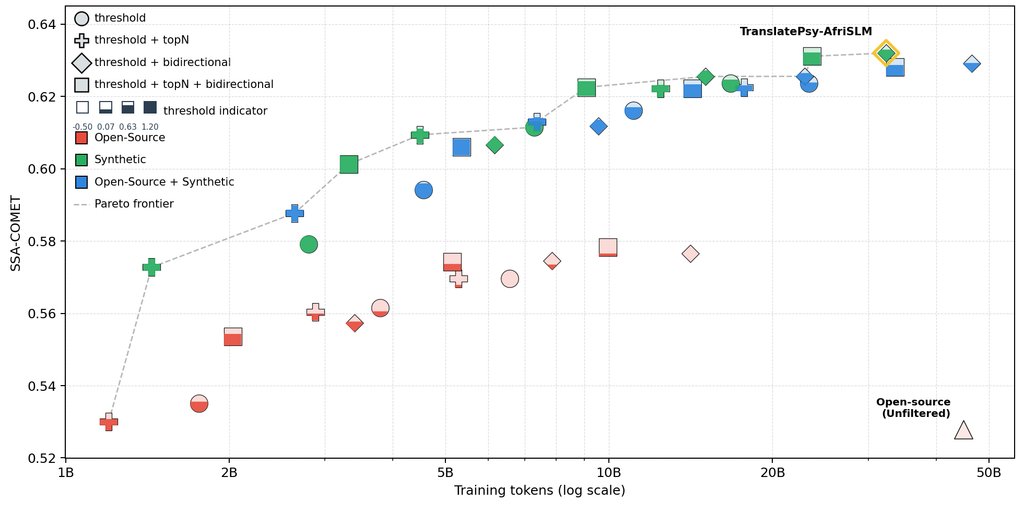
The effect was larger than we expected. Filtering cut the open-source training budget from 44.93 billion tokens to 1.76 billion, a 96% reduction, with no meaningful loss in quality. Carefully generated synthetic data then beat raw open-source data at nearly every training budget we tested. Past a certain point, adding more low-quality data diluted the training signal instead of helping.
For these languages, data quality and curation matter more than model size.
Results
Every number here comes from our forthcoming EMNLP 2026 paper. The full breakdown, including the methodology and the robustness checks, is in the technical write-up.
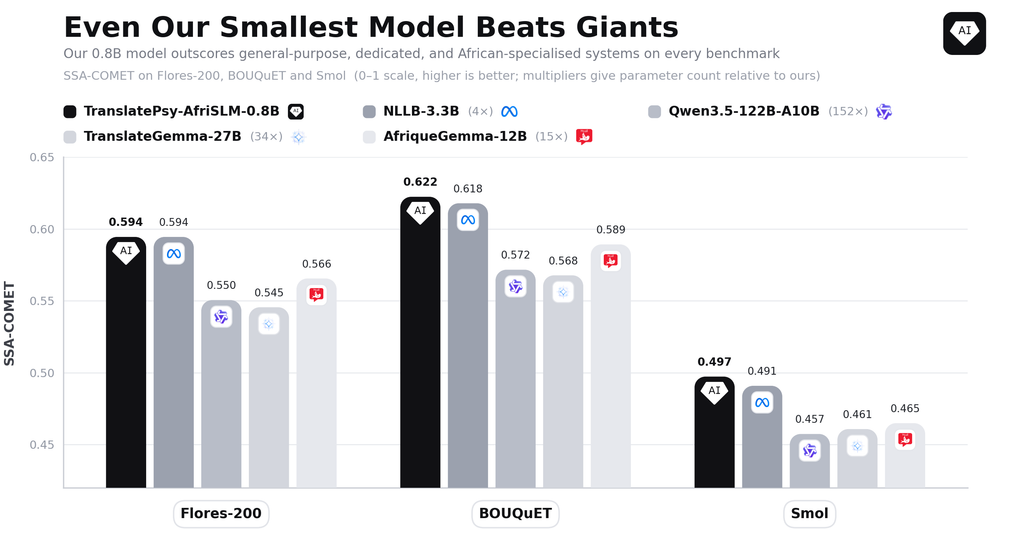
The smallest model beats systems many times its size. Across Flores-200, BOUQuET and Smol, TranslatePsy-AfriSLM-0.8B outperforms Qwen3.5-122B-A10B and TranslateGemma-27B, systems up to 152 times its parameter count. It matches NLLB-3.3B on Flores-200 and surpasses it on the other two, using roughly a quarter of the parameters.
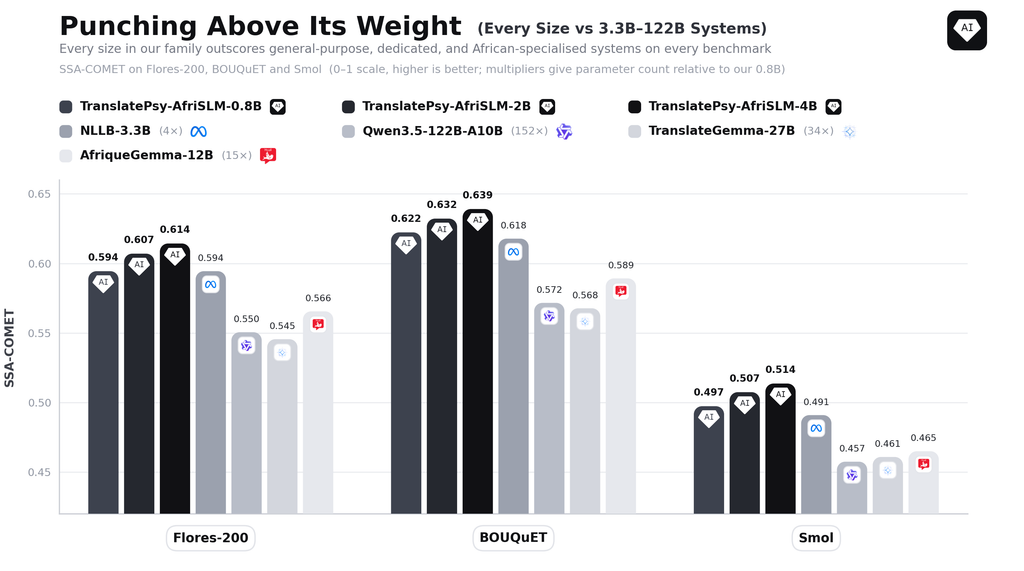
Scaling up keeps helping. Moving from 0.8B to 2B to 4B improves results consistently, and the 4B model posts the strongest SSA-COMET scores across all three benchmarks of any system we evaluated.
The gains reach languages we never trained on. On 8 held-out African languages absent from fine-tuning, the 2B model improves on its own starting point in every case, an average gain of 0.127 SSA-COMET, or 46%. The strongest improvements were on Sepedi, Bambara and Akan.
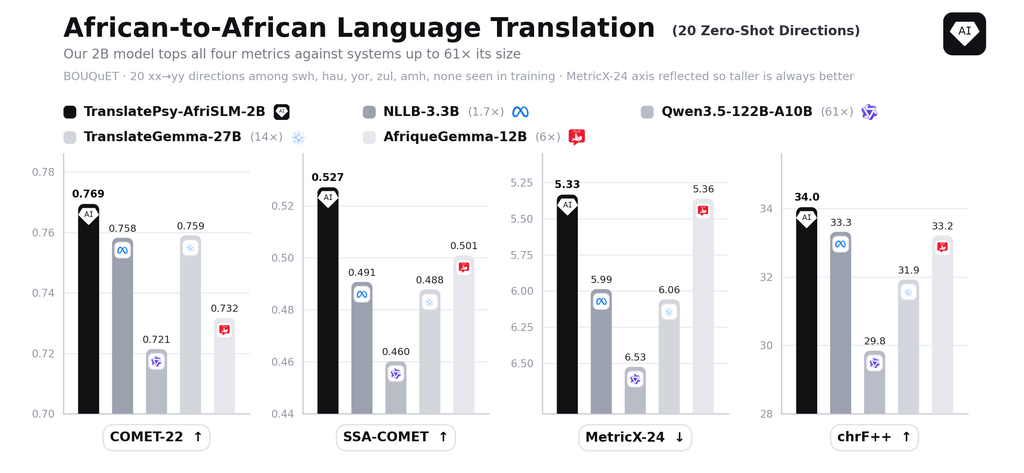
It translates between African languages directly. Our training data pairs English with African languages, so the models never see African-to-African pairs. The 2B model still leads on all four evaluation metrics across 20 zero-shot directions between Swahili, Hausa, Yoruba, Zulu and Amharic, against systems up to 61 times its size. Most translation systems route these languages through English. This one does not have to.
Get it
Model weights, inference code and data-processing scripts are released under Apache 2.0 for research and educational purposes. The synthetic training dataset is released separately under CC-BY-NC 4.0, for non-commercial research and education.
- Models: huggingface.co/collections/qvac/translatepsy-afrislm
- Paper: arxiv.org/abs/2608.18655
- Code: github.com/tether-ai-research/qvac-translatepsy-afri-slm
- Technical write-up: huggingface.co/blog/qvac/translate-psy-afrislm
Copyright complaints: if you believe your work has been used in a way that infringes your rights, email data-apps@tether.io identifying the copyrighted work and the allegedly infringing content.