Local AI 101: what your own machine can run
A phone or an 8 GB laptop handles most everyday AI jobs, and video needs 32 GB. How much memory local AI needs, and the command that tells you what yours has.
Read More
We priced four usage profiles by the tokens they burn each month to find when your own machine costs less than an API or a subscription, and which machine each profile needs.
Part 1 matched everyday jobs to models, and part 2 showed how much memory each one needs. This 3rd part of our Local AI 101 series focuses on the cost, and cost in AI is counted in tokens.
There are three ways to pay for them. A subscription charges a flat price and caps how much you can use. An API bills every token. A machine of your own costs its price once, and each token after that costs almost nothing. Which one is cheapest depends on how many tokens your work burns in a month.
Job | Tokens | Cloud cost |
|---|---|---|
One average request (OpenRouter, end of 2025) | About 6,400 (6,000 read, 400 written) | About 2 cents |
One coding-agent task (a real bug fix from SWE-bench) | About 200,000 | About 50 cents |
A day of agent coding (average developer, one hosted coding agent) | About 5 million (estimated from the $13) | $13 ($150 to $250 a month) |
Mid-range hosted model · $2 per million read, $10 written, 94% read and 6% written · before cache discounts · day of agent coding: the vendor's own average
The average request on OpenRouter at the end of 2025 carried about 6,000 tokens in and 400 out, a number coding tools have pushed up. One run of a coding agent on a single SWE-bench bug fix uses about 200,000. A 2026 study that compared whole sessions found that agentic coding uses about 1,000 times the tokens of a coding question asked in chat, and that the same task can take 30 times more tokens on one run than on another.
Most of those tokens are input. An agent re-reads files and test logs at every step, along with its own history, and pays for each pass. The maker of one popular coding agent puts its average at $13 per developer per active day, or $150 to $250 a month, against $20 for a chat subscription.
Profile | Tokens a month | Subscription | API, mid-range | API, frontier | Open model, cloud | Your machine |
|---|---|---|---|---|---|---|
Light chat, 20 requests a day | 2.8M | $20 | $7 | $14 | $2 | $27 (16 GB laptop) |
Heavy chat, 100 requests a day | 14M | $20 | $35 | $70 | $8 | $27 (16 GB laptop) |
Work agents, 5 agent tasks a day | 22M | $20 to $200, with usage caps | $55 | $109 | $12 | $50 (32 GB laptop) |
Coding agent, 5M tokens a day | 110M | $200, with usage caps | $273 | $546 | $61 | $52 (36 GB desktop) |
US dollars a month · 22 working days · 94% read, 6% written · list prices, no cache discount: mid-range $2 / $10 per million, frontier $4 / $20, open model $0.43 / $2.55 (Qwen3.8-27B at Alibaba) · machine price over 4 years: MacBook Air $1,299, MacBook Pro 32 GB $2,399, Mac Studio 36 GB $2,499 · nothing more if you already own it
We priced four profiles over a working month of 22 days. Light chat is 20 requests a day, heavy chat is 100, work agents run five tasks a day, and a coding agent burns 5 million tokens a day on every working day, about what the $13 average buys at mid-range list prices. The price of a machine bought for the job is spread over four years. Electricity is negligible, even for a laptop running a model all day, so we left it out.
For heavy chat, the subscription wins. At 100 requests a day it costs $35 through a mid-range API and $20 on a plan, and a 16 GB laptop bought only for this would cost $27 a month over four years. Light users pay less through an API than through a plan.
Agents change the order. The coding profile costs $273 a month on a mid-range API, $546 on a frontier one, and $52 on a 36 GB Mac Studio ($2,499) running Qwen3.6 35B. A $200 plan costs less than the API, but every plan caps usage, and the caps are tightest on the best models. On the $20 ChatGPT Plus plan, that means 5 to 45 coding messages per five hours on the top model, against 350 to 3,000 on the smallest.
Open models on a cloud API cost far less than the frontier. Alibaba, which makes Qwen, serves Qwen3.8-27B for $0.43 per million tokens read and $2.55 per million written, so the coding profile costs about $61 a month there, against $52 on a machine of your own. Smaller providers on OpenRouter go down to $0.02 per million read, running the model at reduced precision.
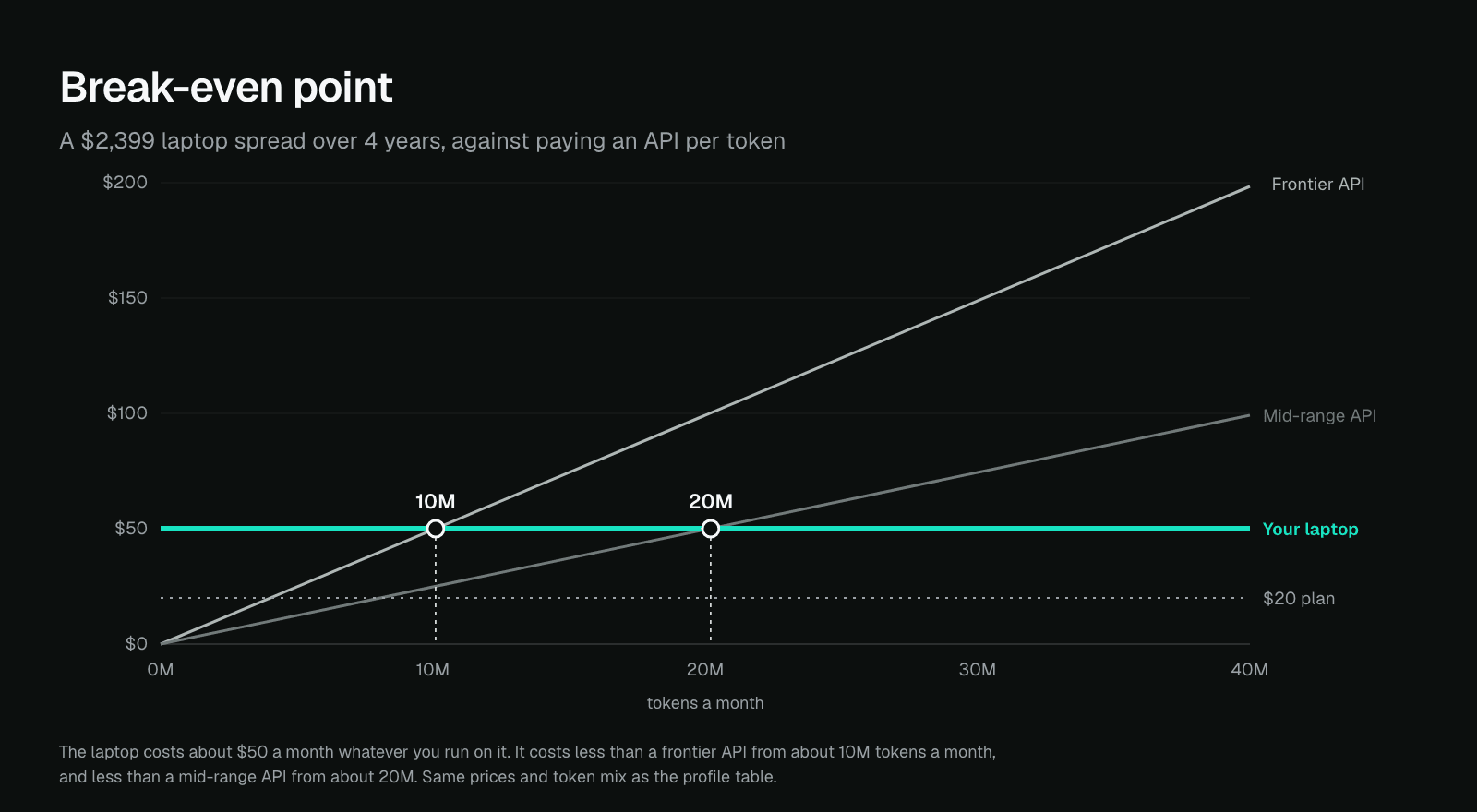
A 32 GB laptop at $2,399 costs about $50 a month over four years, whatever you run on it. It becomes cheaper than a frontier API from about 10 million tokens a month and cheaper than a mid-range API from about 20 million, which the work-agents profile passes. Against an open model on a cloud API, it takes about 90 million, more than Qwen3.8-27B can get through on it in a month. If you already own the machine, there is nothing to pay back.
Model | Memory | Writes | Reads | Most per working month |
|---|---|---|---|---|
Qwen3.5 4B | 2.6 GB | 96 tok/s | 815 tok/s | About 360M |
Qwen3.5 9B | 5.3 GB | 61 tok/s | 486 tok/s | About 220M |
Qwen3.6 35B (mixture of experts: all 35B in memory, 3B used per token) | 21 GB | 78 tok/s | 401 tok/s | About 200M |
Qwen3.8-27B (dense: all 27B used per token) | 18 GB | About 16 tok/s | About 120 tok/s | About 55M |
Working month of 176 hours · 94% read, 6% written · QVAC SDK on a MacBook Pro M5 Max, 36 GB
A machine can only process so many tokens in a working month. Qwen3.6 35B is a mixture of experts, with only about 3 billion of its 35 billion parameters working on each token, so it reads 400 tokens a second and handles about 200 million a month. Qwen3.8-27B scores 86.0% on SWE-bench Verified, a test built from real bug fixes, but uses all 27 billion parameters every time. It reads about 120 tokens a second and tops out near 55 million a month, enough for work agents but not for the coding profile on one laptop.
Reading is the limit, and agents mostly read. A first pass over 100,000 tokens of code takes about four minutes with Qwen3.6 35B and about 14 with Qwen3.8-27B.
The same machine also gets more capable after you buy it, with no extra memory. Qwen reported 77.2% on SWE-bench Verified for Qwen3.6-27B in April, and Vals.ai measured Qwen3.8-27B at 86.0% in September, both in about 18 GB, though the two scores come from different test setups. The software improves too: a change we contributed to llama.cpp, merged on 5 October, makes speculative decoding on a Mac up to 3.4 times faster than plain decoding when writing code, 110 tokens a second against 32. Reading speed is unchanged by it.
Memory | Model | Handles | Mac | Windows |
|---|---|---|---|---|
8 GB | Qwen3.5 4B | Chat, writing, summaries | MacBook Neo, $699 | Entry laptops with 8 GB |
16 GB | Qwen3.5 9B, FLUX.2 Klein for images | Adds photos, documents and images | MacBook Air M5, $1,299 | Dell 16 Laptop, $949.99 (processor only: 5 to 13 tok/s on a 7B model) |
32 to 36 GB | Qwen3.8-27B, or Qwen3.6 35B on 36 GB, faster | Agents for work and for code | MacBook Pro 14" M5 32 GB, $2,399; Mac Studio 36 GB, $2,499 | Ryzen AI Max with shared memory, e.g. Framework Desktop (64 GB), $1,959 |
US list prices, October 2026.
With 8 GB, Qwen3.5 4B handles chat, writing and summaries, and the $699 MacBook Neo has that much. With 16 GB, Qwen3.5 9B adds questions about photos and documents, and FLUX.2 Klein makes images. A MacBook Air ($1,299) has 16 GB, and so does a Windows laptop like the Dell 16 ($949.99). The Dell has no separate graphics card, so it runs the model on its processor, and community benchmarks put laptops like it at 5 to 13 tokens a second written on a 7B model.
Agents for work and agents for code need the same class of machine, with 32 to 36 GB, and a coding agent that runs all day keeps up best with Qwen3.6 35B on 36 GB. Qwen3.8-27B takes about 18 GB and fits a MacBook Pro with 32 GB ($2,399). On Vals.ai's SWE-bench Verified it scores 86.0%, 11 points below the best hosted model at 97.0%. Qwen3.6 35B is faster and needs about 21 GB, which fits a 36 GB machine.
On a Windows PC with a graphics card, the model runs fastest when it fits in the card's own memory, 8 to 24 GB on current laptops. Whatever does not fit spills into slower system memory. A laptop with a 12 GB RTX 5070 Ti still wrote 43 tokens a second with a 30B mixture-of-experts model, more than half of it in system memory. Machines built on AMD's Ryzen AI Max share one pool of memory like a Mac does: the Framework Desktop with 64 GB costs $1,959, and benchmarks put Qwen3.6 35B on that chip at 51 to 60 tokens a second written and about 1,100 read.
A model on your own machine keeps answering on a plane, during a provider outage or after a plan's limit has run out, and nobody can change its terms or retire the copy you downloaded. The model itself sends nothing anywhere, so your prompts and files stay on that machine unless a tool you connect to it sends them out. An open model served through a cloud API is cheap, but your prompts and files still go to someone else's server and sit under that provider's retention policy.
Check how much memory your machine has and try the model suggested above for it. Then estimate your monthly tokens: past about 10 million on a frontier API, or 20 million on a mid-range one, a 32 GB machine of your own costs less.
QVAC is free and open source: github.com/tetherto/qvac
A phone or an 8 GB laptop handles most everyday AI jobs, and video needs 32 GB. How much memory local AI needs, and the command that tells you what yours has.
Read More
We built Genesis III to push small models as far as they can go on STEM. A 1.7B model trained on it answers more than twice as many questions correctly as the same model trained on the open alternative, from an identical token budget.
Read More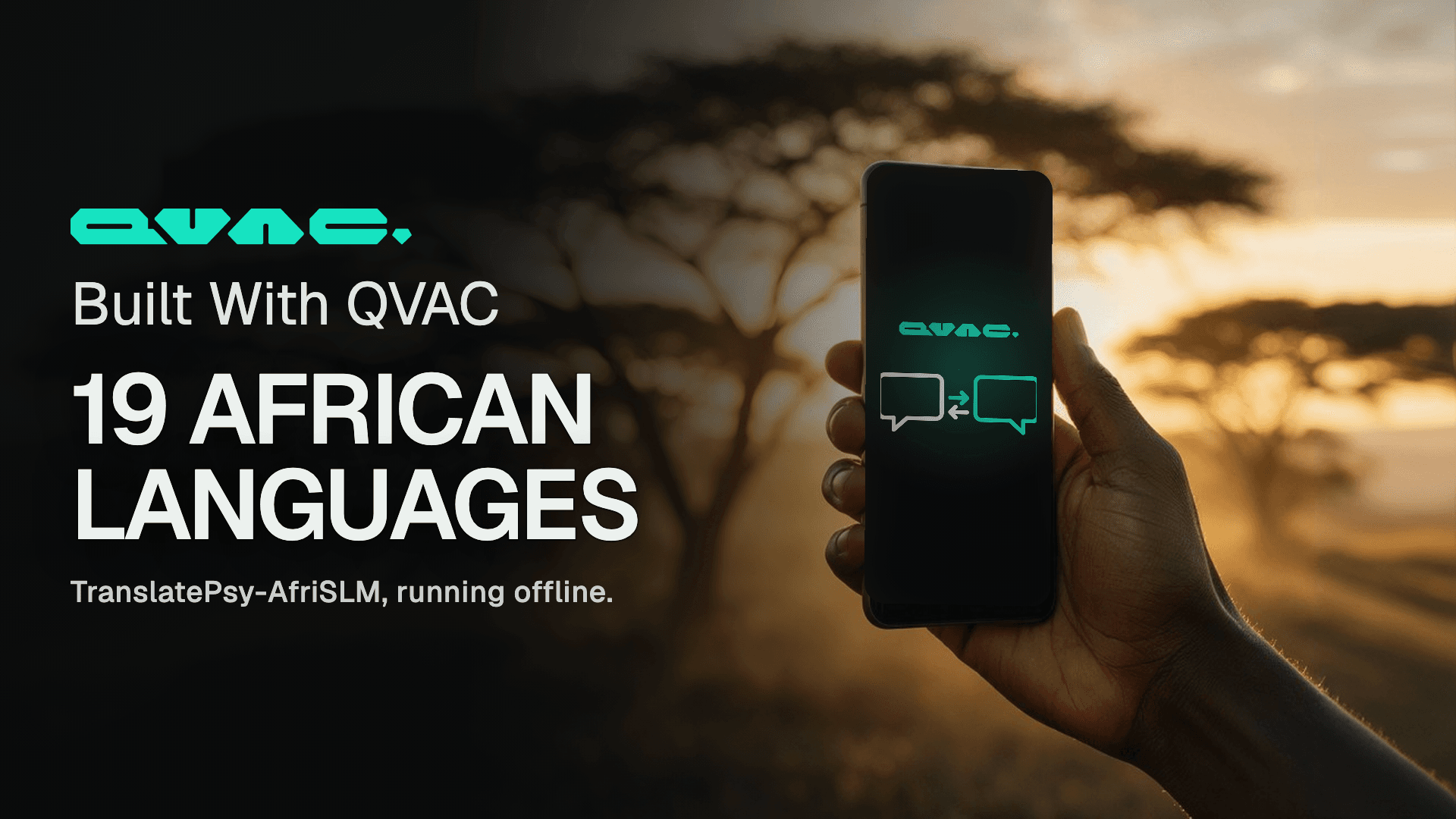
TranslatePsy-AfriSLM is our translation model for 19 African languages, small enough to run on a phone. We built a demo on it: paste text or photograph a page, and read it in your language, with no connection and nothing to pay.
Read MoreA phone or an 8 GB laptop handles most everyday AI jobs, and video needs 32 GB. How much memory local AI needs, and the command that tells you what yours has.
Read MoreWe built Genesis III to push small models as far as they can go on STEM. A 1.7B model trained on it answers more than twice as many questions correctly as the same model trained on the open alternative, from an identical token budget.
Read MoreTranslatePsy-AfriSLM is our translation model for 19 African languages, small enough to run on a phone. We built a demo on it: paste text or photograph a page, and read it in your language, with no connection and nothing to pay.
Read MoreStay updated
New versions, breaking changes and migration notes - straight to your inbox. No spam, unsubscribe anytime.