Built with QVAC: a translation demo running TranslatePsy-AfriSLM on your phone
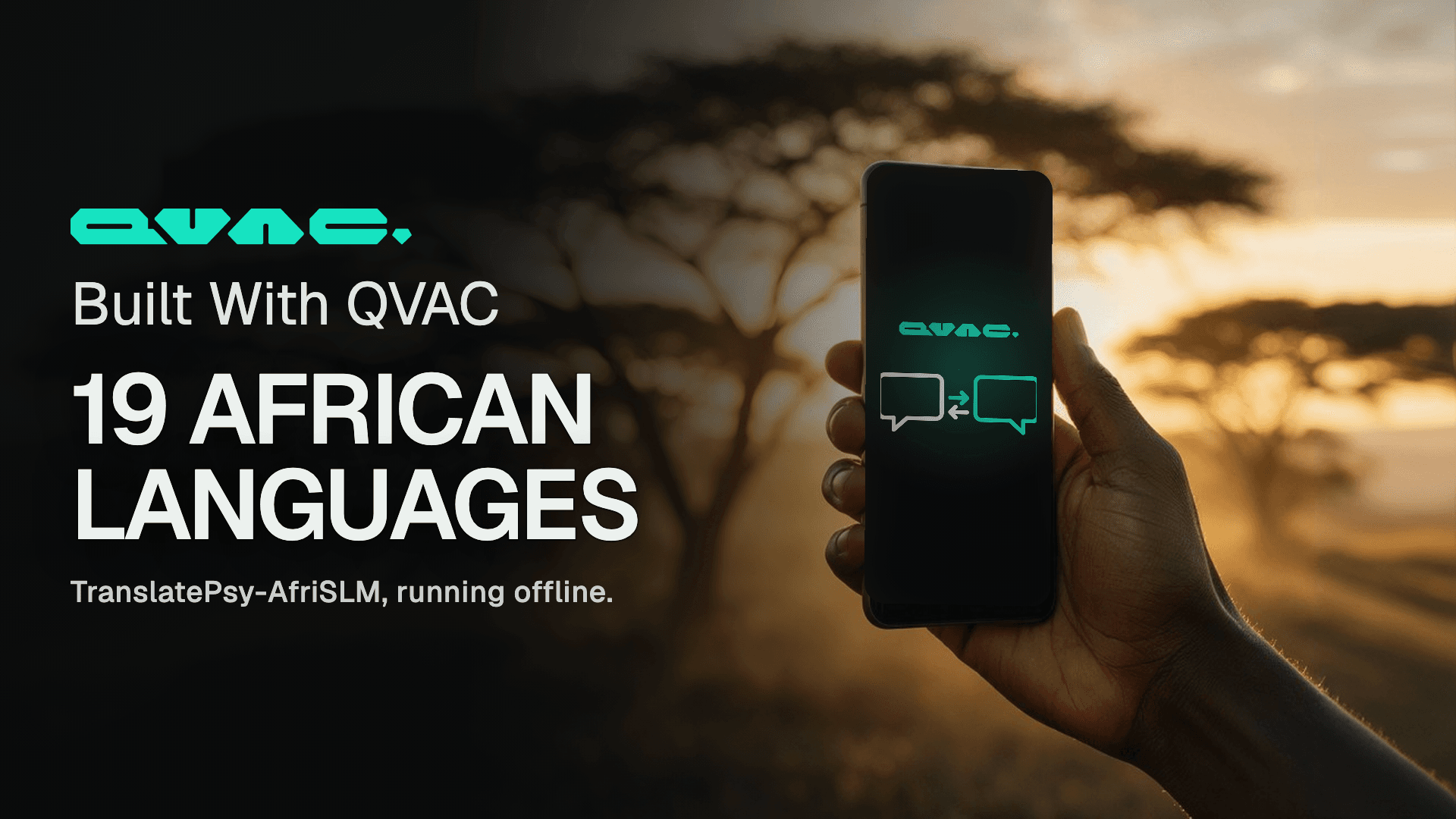
TranslatePsy-AfriSLM is our translation model for 19 African languages, small enough to run on a phone. We built a demo on it: paste text or photograph a page, and read it in your language, with no connection and nothing to pay.
T
Thomas Blanc
TranslatePsy-AfriSLM is our translation model for 19 African languages, in sizes small enough to run on a device somebody already owns. We built a demo for anyone to try freely.
Translation is where QVAC and Tether have put real research effort, because it is the door everything else goes through. A school notice, a farming leaflet, a health instruction, a form: none of them reach a person if they exist only in a language that person does not read. Where language support does exist it usually sits behind a cloud service, which needs a connection and a payment method, and across much of Africa both are the exception.
What the demo does
Paste or type text and translate it between English and any of the 19 languages, in either direction.
Photograph a page and it comes back translated.
One African language straight into another, Swahili into Oromo, with no English in the middle.
Works with the network off once the model is on disk. No account, no API key, nothing to pay.
It picks the model for your machine. The model comes in six versions and the demo does not ask you to choose: it looks at the machine, takes the strongest size that will run well on it, and uses one already on the disk if there is one.
The scan feature: combining AfriSLM with a vision model
TranslatePsy-AfriSLM translates text. Pair it with a QVAC vision model in the same app and you get the scan feature: the vision model reads the words off the photograph, you can correct them, and TranslatePsy-AfriSLM translates them. Both models run locally, one after the other.
Where it fits
Good for:
Reading a page in a language you do not read, on a device with no signal.
School notices, timetables, forms, leaflets, a message from a relative.
Getting the gist of something quickly, for free, without uploading it.
Less good for:
Anything with important implications.
Running a service on. It is an example to clone and learn from.
Reminder: Always perform adequate testing before deploying in any critical AI applications.
Recommended hardware
Model Size
Download
Phones it runs on
Laptops it runs on
0.8B
0.67 GB
an 8 GB phone: iPhone 16, or a mid-range Android
any 8 GB laptop, a MacBook Air M1
2B
1.56 GB
a 12 GB phone: Galaxy S25, iPhone 16 Pro Max
a 16 GB laptop, a MacBook Air M2 or M3
4B
3.07 GB
flagship only, 16 GB
16 GB and up, a MacBook Pro or a discrete GPU
The phone column is the reason these sizes exist: TranslatePsy-AfriSLM is published as GGUF for on-device deployment and the release notes it as running on an ordinary phone with no GPU and no connection. Both columns are guidance from the download size against the memory those devices have, rather than a benchmark run on each one.
This particular demo is a local web app, so it runs on a laptop or a desktop: macOS 14+, Windows 10+ or Linux, with Node.js 22.17 or newer. Apple Silicon uses Metal, a Vulkan GPU works too, and CPU is slower but fine at the smaller sizes. Putting the same model into a mobile app is a separate build, and the model sizes above are what make it possible.
The demo measures your machine and picks a size, so the table is background rather than something to work out. Not sure it will run at all? npx -y @qvac/cli doctor.
Open http://localhost:3065. There is nothing to install: the app resolves the SDK from the qvac CLI already on your PATH. It measures the machine, downloads a size, and asks whether you also want the vision model for scanning paper.
QVAC is open source and free, and the docs are at docs.qvac.tether.io. If you build something with it, star the repo and show us.
A note on what this is
This is an illustrative example. QVAC and Tether do not sell it as a product, and it shouldn't be seen as a final product. It ships as-is, with no support and no warranty. You alone are responsible for how you use it.
Combining TranslatePsy-AfriSLM with a vision model to read photographed pages is something we put together for this demo, and it has not been extensively tested by the research team. Treat the scan path as a demonstration of what the two models can do together.
TranslatePsy-AfriSLM's weights are Apache 2.0, released for research and educational purposes. Its synthetic training data carries a different licence, CC-BY-NC 4.0, and the two should never be quoted as one. The model covers 19 fine-tuned languages, with 8 more reported as a transfer result rather than a support claim. The paper is a forthcoming EMNLP 2026 submission, live now as a preprint at arxiv.org/abs/2608.18655.
Our engineering team has been optimising the QVAC audio stack, so we measured it. We put qvac-fabric-speech.cpp against the open-source engines people run for transcription, speech synthesis and music generation, on four machines and six GPU lanes, timing every engine from outside its own process so that nobody's own stopwatch is quoted. QVAC leads on the GPU lanes we measured, across every vendor. Here is each number, and how we took it.
Running AI on your own machine raises two questions at once: which models your laptop can actually run, and which model to use for which task. This first part answers the second one, job by job, across chat, documents, speech, translation, images and video. Every model listed runs through QVAC, the free and open-source toolkit we build for local AI, on laptops and on phones, with nothing leaving your device.
Searching your own documents with AI means comparing your question against every vector you have stored, and that gets slow and memory-hungry as the collection grows. TurboVec is a vector index that makes the search faster and the stored vectors much smaller, with no training step over your data. It is available in the QVAC SDK, and the RAG code you already write does not change.
Our engineering team has been optimising the QVAC audio stack, so we measured it. We put qvac-fabric-speech.cpp against the open-source engines people run for transcription, speech synthesis and music generation, on four machines and six GPU lanes, timing every engine from outside its own process so that nobody's own stopwatch is quoted. QVAC leads on the GPU lanes we measured, across every vendor. Here is each number, and how we took it.
Running AI on your own machine raises two questions at once: which models your laptop can actually run, and which model to use for which task. This first part answers the second one, job by job, across chat, documents, speech, translation, images and video. Every model listed runs through QVAC, the free and open-source toolkit we build for local AI, on laptops and on phones, with nothing leaving your device.
Searching your own documents with AI means comparing your question against every vector you have stored, and that gets slow and memory-hungry as the collection grows. TurboVec is a vector index that makes the search faster and the stored vectors much smaller, with no training step over your data. It is available in the QVAC SDK, and the RAG code you already write does not change.