TranscribePsy: on-device speech recognition in 25 European languages
TranscribePsy is a 254M-parameter speech recognition model that turns speech into text on a phone or a laptop, in 25 European languages on a laptop and 8 on a phone.
Read More
Paolo Ardoino answered the community’s questions about QVAC and local AI: why AI should run on the devices people own, who pays for the compute and what a cheap phone can do today.
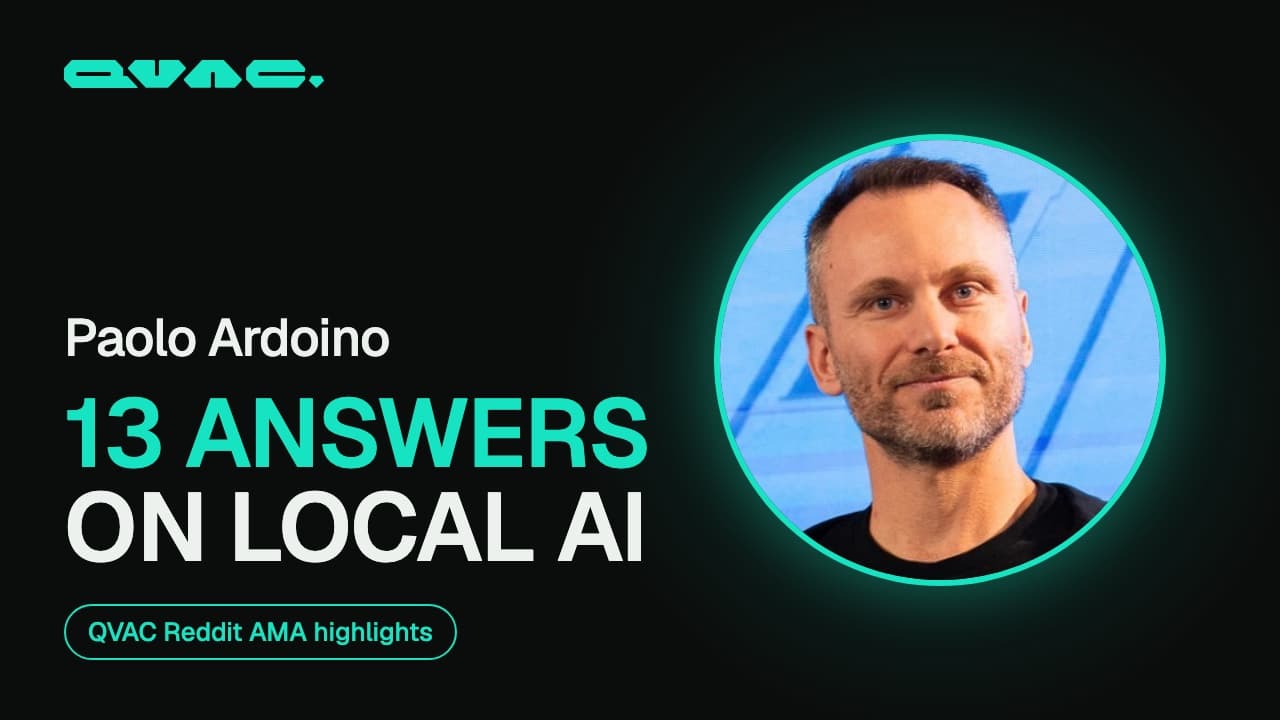
On 7 October, Paolo Ardoino, CEO of Tether, answered the community's questions about QVAC and local AI in an AMA on Reddit. He recorded his answers on video, and they cover why AI should run on the devices people already own, who pays for the compute, what a cheap phone can do today and why a stablecoin company builds AI.
You can read every question and answer in the AMA thread on Reddit, or watch the 7-minute highlights on YouTube.
Paolo argues that AI should be local first: owned by the people who use it and available to everyone. He called local-first AI "one of the most important tech movements of the last 100 years". In his view, a future where two, three or four companies handle the intelligence of the whole world "does not make any sense", for privacy, for resilience and for control.
For billions of people, he said, the nearest data center is far away, and the speed of light puts a floor under the delay. A car or a robot that has to react in a fraction of a second cannot wait for a server, and it cannot stop working when the connection drops. QVAC's vision starts from the same point: intelligence that runs where the person is.
Asked who pays for the compute if local AI is a universal right, Paolo said a handful of companies are trying to pay for the energy and hardware behind everyone's AI today, and he does not believe it can last: "Will not work, will fail miserably." With local AI, people pay for the electricity they already pay for when they charge a phone or a laptop, and energy production is spread out instead of being concentrated in a few countries.
With millions of developers building their own versions of local AI, each shaped by where it runs, the way those versions evolve and mix would be "almost like genetic algorithms for local AI", he said, and would take AI in more directions than a few companies deciding for everyone. For the numbers on the cost side, our Local AI 101 piece on what AI costs, counted in tokens compares a machine of your own with an API and a subscription.
Paolo says plainly that a phone does not match a frontier model today. Most people do not need one for everyday work, he argues, and open models are quickly catching up on summaries, transcription, translation, documents and medical questions. The hardest problems, in physics, maths or biology, may stay in large data centers, and he expects governments to fund much of that work.
In his closing message he said half of everyday AI tasks can already run on a phone, 70% on laptops and phones in three years, and between 85 and 95% in five. He also counts on the chipmakers: Qualcomm, AMD, Nvidia, Apple and Samsung are all competing on local AI performance, and he expects hardware that is expensive today to become affordable for most people in the West within three to five years, and in poorer countries a little later.
Some phones in the $80 range, which are common in Africa, can already run models of 0.6 to 2 billion parameters "in a decent way", he said. "It's perfect? Of course not," he added, but Tether wanted to show that it is possible today, not in five years. QVAC's own models are built small so they fit phones like these. Hiraia, an AI science tutor for Filipino students built on the QVAC SDK, runs on Android phones with 6 GB of RAM and needs no connection after a one-time download. To see what your own device can handle, read what your own laptop or phone can run.
Paolo describes AI as becoming an extension of our own minds, which is why he thinks it has to stay private. People should be able to bring their worries and their weaknesses to an AI, and "you don't want to do that with the centralized AI tools." With QVAC, tasks such as transcription, translation, OCR and summaries run on the device, so the questions and the answers stay with the person who asked them. TranscribePsy, our speech recognition model, is a recent example: it turns speech into text without the recording leaving the phone.
QVAC is open source under Apache 2.0, so anyone can contribute, Paolo said: add features, improve stability, support new models and open pull requests on GitHub. Tether is also hiring developers and AI researchers at careers.tether.io, keeps posting bounties for new features, and is open to looking at projects built on QVAC that it could fund. The QVAC SDK is the place to start, with a quick start for your first local AI app.
He closed the AMA with his own version of a Bitcoin saying: "not your AI, not your intelligence."
Watch the highlights on YouTube
To ask questions or get help along the way, join r/QVAC_AI, the QVAC community on Reddit.
TranscribePsy is a 254M-parameter speech recognition model that turns speech into text on a phone or a laptop, in 25 European languages on a laptop and 8 on a phone.
Read More
We priced four usage profiles by the tokens they burn each month to find when your own machine costs less than an API or a subscription, and which machine each profile needs.
Read More
A phone or an 8 GB laptop handles most everyday AI jobs, and video needs 32 GB. How much memory local AI needs, and the command that tells you what yours has.
Read MoreTranscribePsy is a 254M-parameter speech recognition model that turns speech into text on a phone or a laptop, in 25 European languages on a laptop and 8 on a phone.
Read MoreWe priced four usage profiles by the tokens they burn each month to find when your own machine costs less than an API or a subscription, and which machine each profile needs.
Read MoreA phone or an 8 GB laptop handles most everyday AI jobs, and video needs 32 GB. How much memory local AI needs, and the command that tells you what yours has.
Read MoreStay updated
New versions, breaking changes and migration notes - straight to your inbox. No spam, unsubscribe anytime.