TranscribePsy: on-device speech recognition in 25 European languages
TranscribePsy is a 254M-parameter speech recognition model that turns speech into text on a phone or a laptop, in 25 European languages on a laptop and 8 on a phone.
T
Thomas Blanc
QVAC TranscribePsy, released by Tether AI Research on 14 October 2026, is a 254M-parameter speech recognition model that turns speech into text on a phone or a laptop. It covers 25 European languages on a laptop and 8 on a phone. It makes fewer mistakes than every similar-size model we compared, and its phone build was the fastest model on all six phones we tested. The weights are free under Apache 2.0.
More and more of the devices we talk to have no keyboard, from smart glasses to robots in the home. Before any of them can act on what you said, something has to write it down. Today that step mostly runs in a data center.
Privacy. Cloud transcription means the recording leaves your device and lands on a company's server. A voice recording carries what you said and, through your voice, who you are. Once it sits on someone else's server, you no longer control who keeps it or what it is used for.
Latency. The speed of light sets a floor on any round trip to a data center, and no engineering removes it. In optical fiber, light covers about 200 km per millisecond, so a server 3,000 km away costs at least 30 ms there and back before any processing starts, and a mobile network adds more on top, more again on a weak signal. On glasses or a robot that has to react to what you say, that wait is built into every exchange, and when the signal drops, the round trip does not happen at all.
Running on the device solves both. Size is the hard part: a phone gives each app a small slice of memory, and its chip slows down under sustained load. The speech models small enough for a phone give up a lot of accuracy, especially outside English. The accurate ones are three to four times larger, need two to three times the memory and take 7.5 to 15 times longer on the same phone. TranscribePsy was built to be both small and accurate.
What can you do with TranscribePsy?
Dictation and voice notes. Speak, and on an iPhone's Neural Engine the text is ready about a quarter of a second after you stop.
Meeting and lecture transcripts. Record a meeting or a lecture on your phone and transcribe it there, without uploading it.
Captions for accessibility. It writes captions for recorded talks and videos, for people who are hard of hearing, with no connection needed.
Private conversations. An interview or a consultation can be written down without the audio leaving the device.
Voice controls that work offline. An app can take spoken commands in a tunnel, on a plane or anywhere with no network.
How accurate is it?
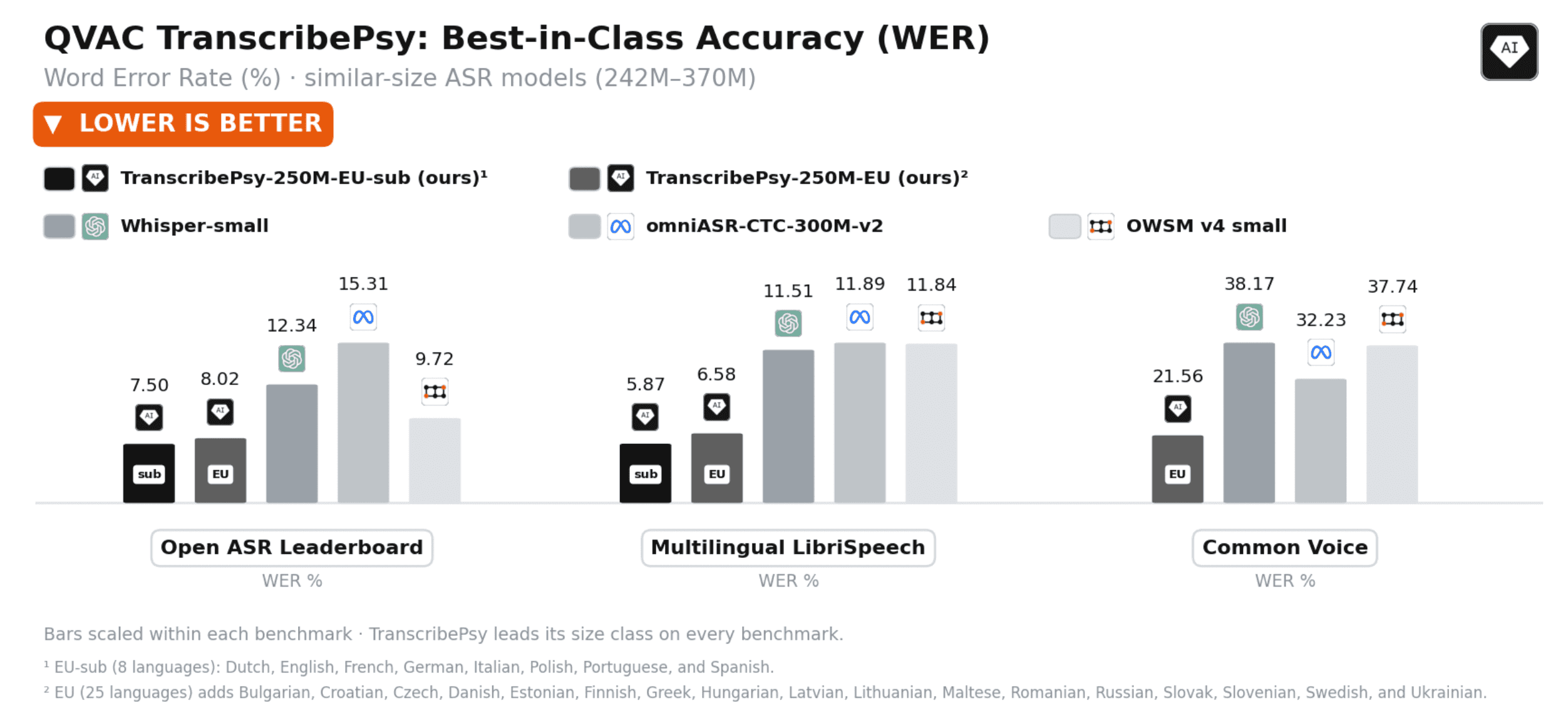
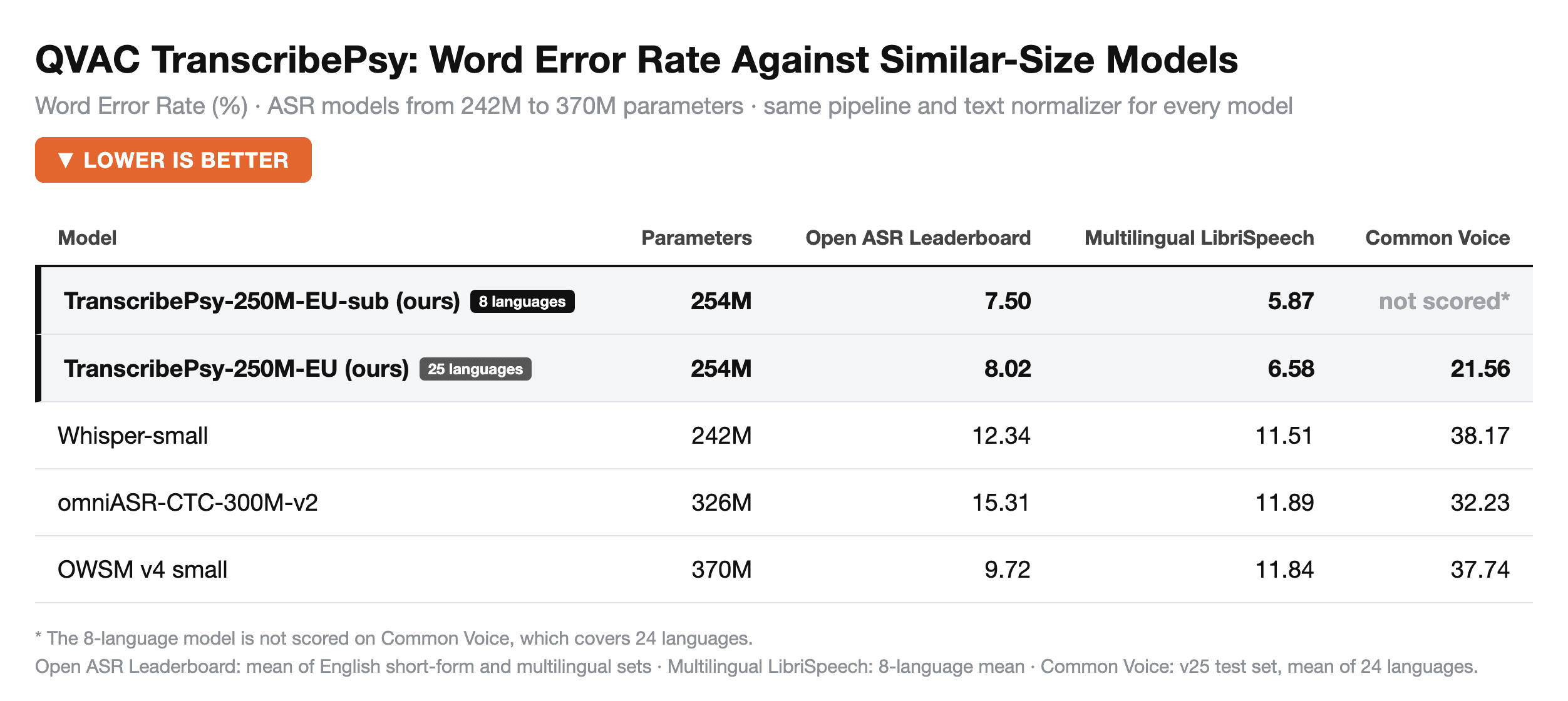
Accuracy is measured as word error rate: the number of word errors (words substituted, dropped or added) per 100 words of the reference transcript, so lower is better. Every model below was decoded and scored with the same pipeline and the official Open ASR Leaderboard text normalizer, so the numbers compare directly.
Against models of its size (242M to 370M parameters), TranscribePsy has the lowest error on all three benchmark suites. On Multilingual LibriSpeech, averaged over its eight languages, it makes 6.58 word errors per 100 words, against 11.51 for Whisper-small, 11.84 for OWSM v4 small and 11.89 for omniASR-CTC-300M-v2: roughly half the errors of every model in its class.
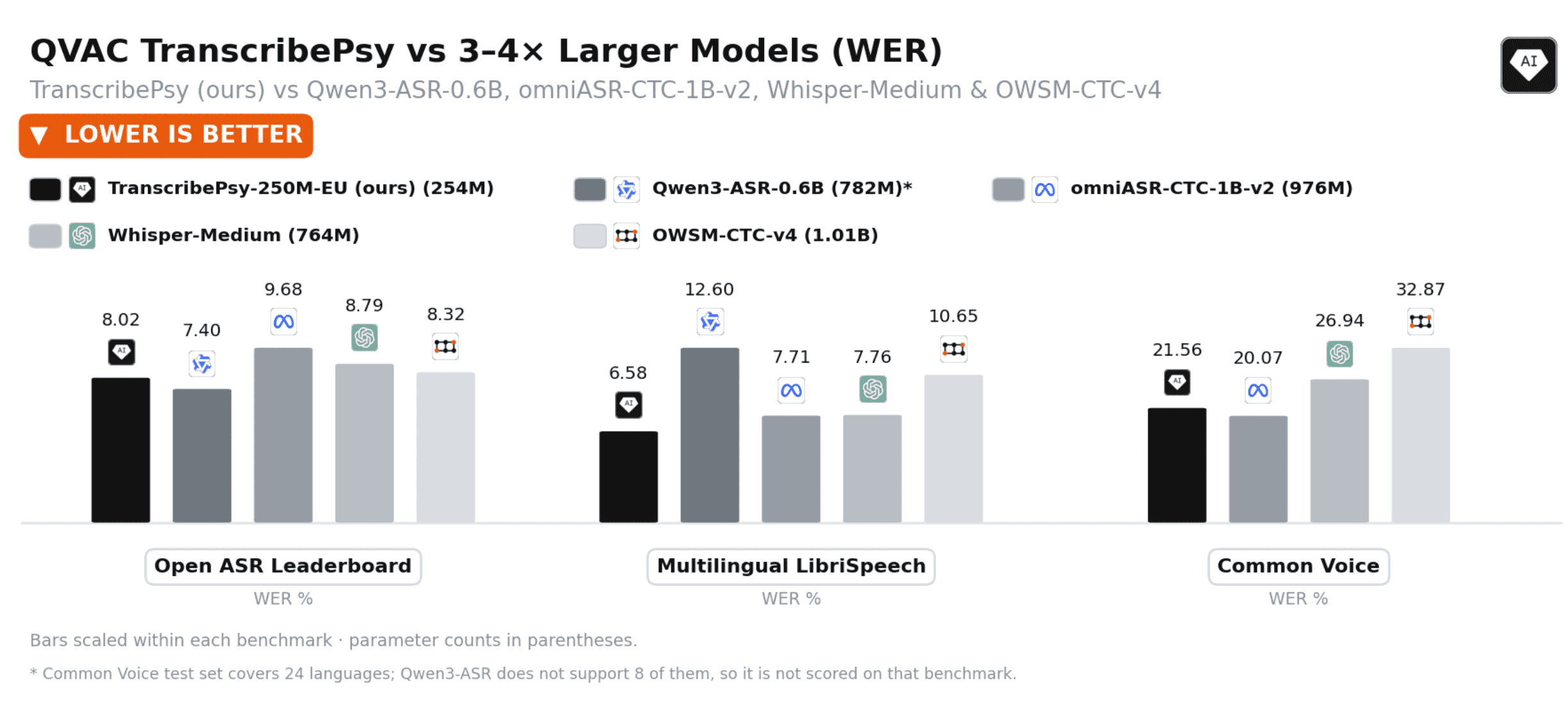
Against four models three to four times its size, it has the lowest error on Multilingual LibriSpeech: 6.58, against Qwen3-ASR-0.6B (12.60), OWSM-CTC-v4 (10.65), Whisper-Medium (7.76) and omniASR-CTC-1B-v2 (7.71). On the other two benchmarks one of them is ahead: Qwen3-ASR-0.6B on the Open ASR Leaderboard (7.40 against 8.02) and omniASR-CTC-1B-v2 on Common Voice (20.07 against 21.56).
How fast is it on a phone?
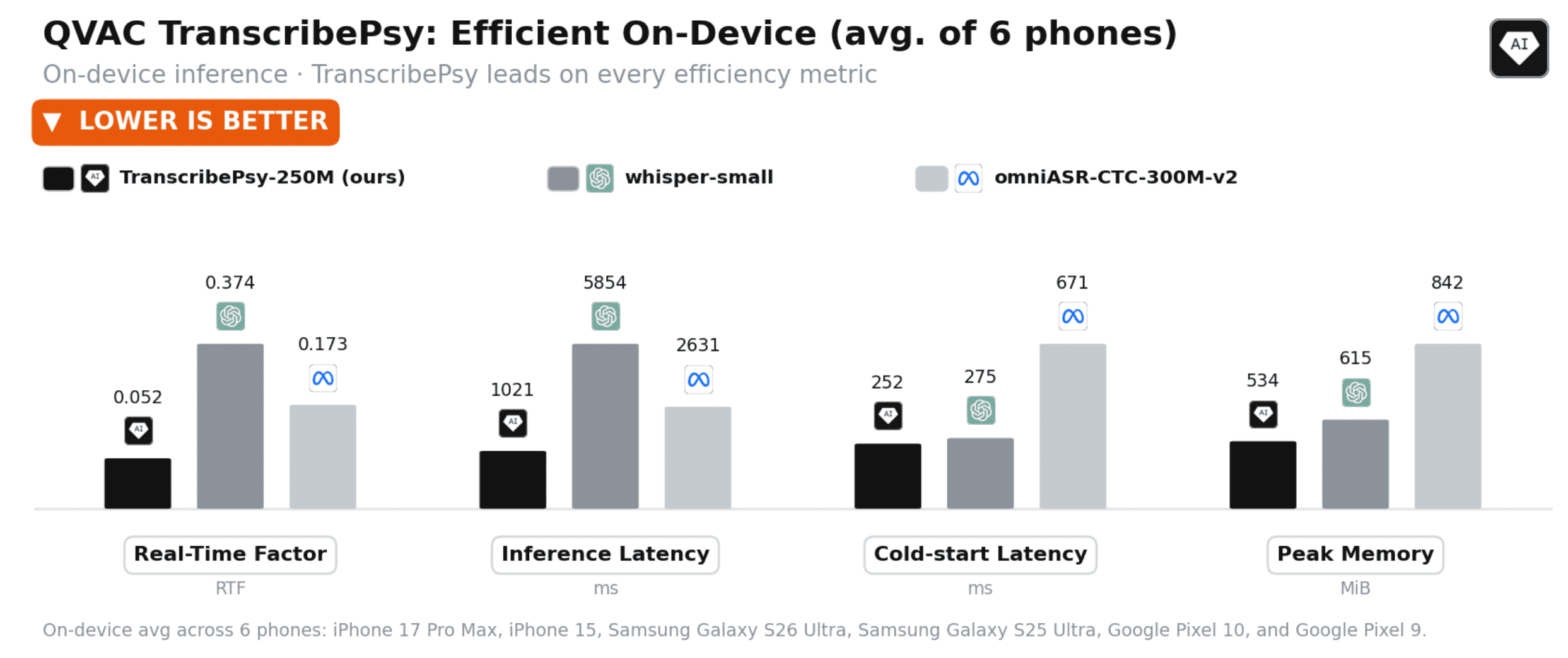
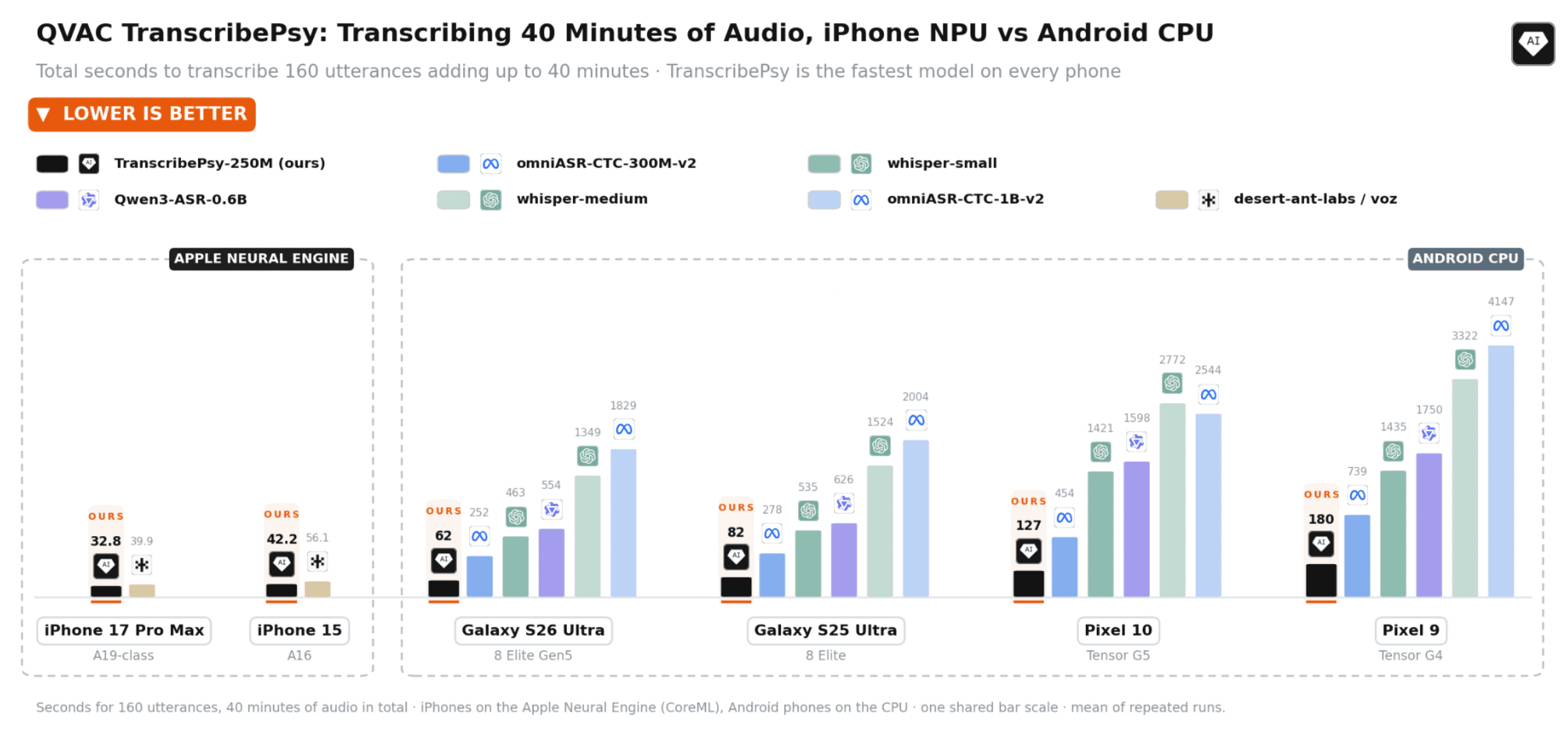
We measured every model on six real phones: iPhone 17 Pro Max, iPhone 15, Samsung Galaxy S26 Ultra, Galaxy S25 Ultra, Google Pixel 10 and Pixel 9. Each one transcribed the same 160 utterances, 40 minutes of audio drawn from Multilingual LibriSpeech in eight languages, and every figure is the mean of the best three of five runs, so heat throttling between runs stays out of the numbers.
The 8-language model was the fastest on all six. Averaged across the phones' CPUs, its GGUF build answers an utterance in 1,021 ms, against 2,631 ms for omniASR-CTC-300M-v2, the next-fastest, and 5,854 ms for Whisper-small. It loads in 252 ms on average, and its peak memory stays between 530 and 542 MiB on every device, which matters when a phone decides which app to close.
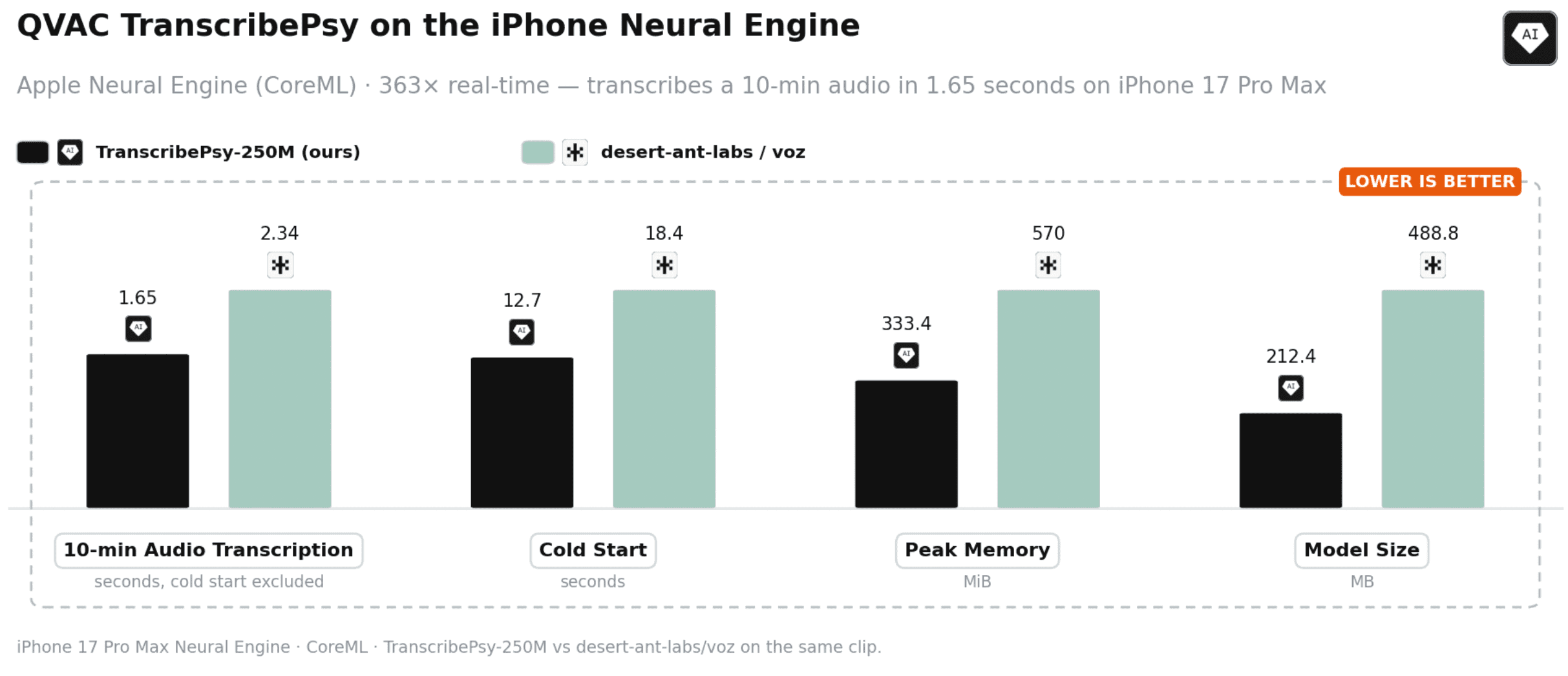
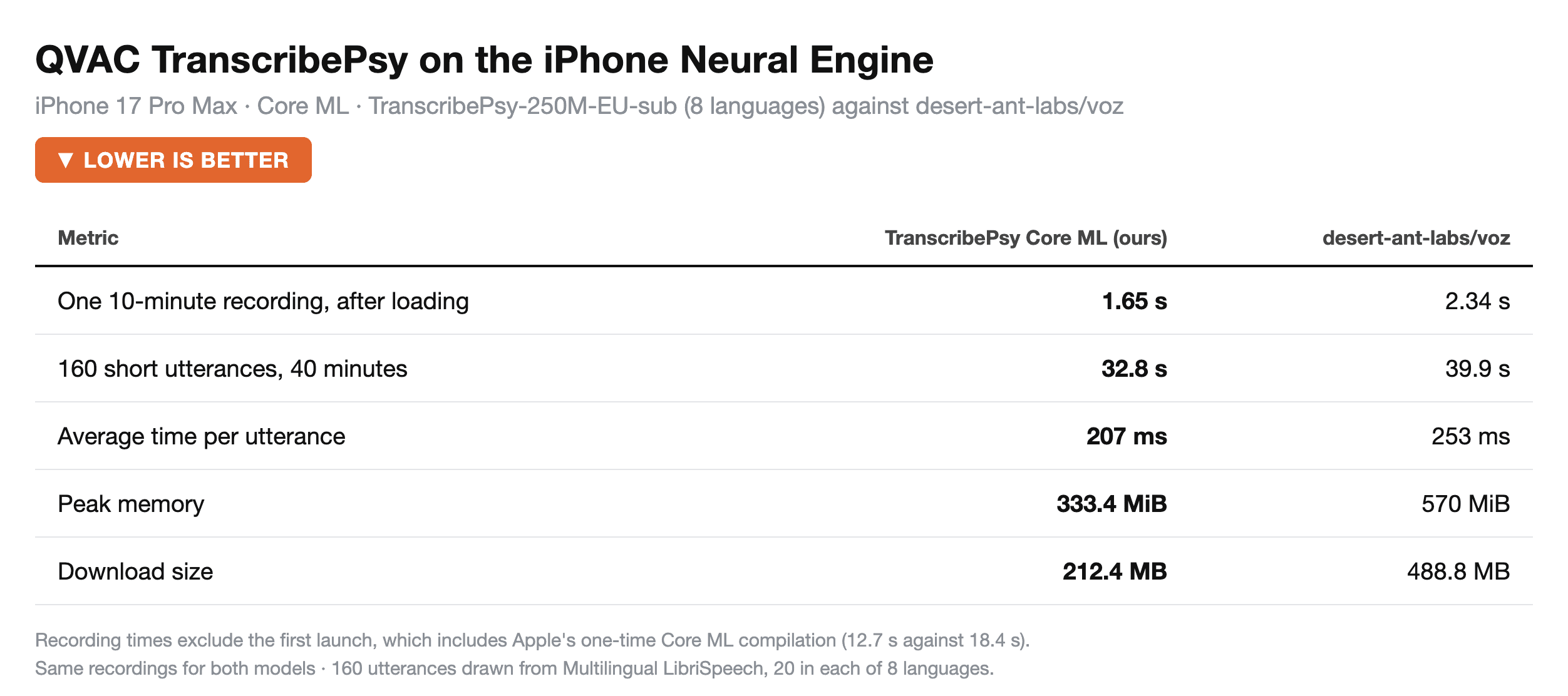
A Core ML build runs on the iPhone's Neural Engine, the part of the chip built for AI. On an iPhone 17 Pro Max, the 8-language Core ML build transcribes a single 10-minute recording in 1.65 seconds once loaded, 363 times faster than real time. The other Core ML speech model we compared, desert-ant-labs/voz, takes 2.34 seconds on the same recording, with a download 2.3 times larger and 1.7 times the memory.
On the iPhone 15's Neural Engine the full 40-minute set takes 42.2 seconds. On the Android phones, where the GGUF build runs on the CPU, the same set takes 62 seconds on the Galaxy S26 Ultra and 180 seconds on the Pixel 9, the slowest of the six.
Which version should I use?
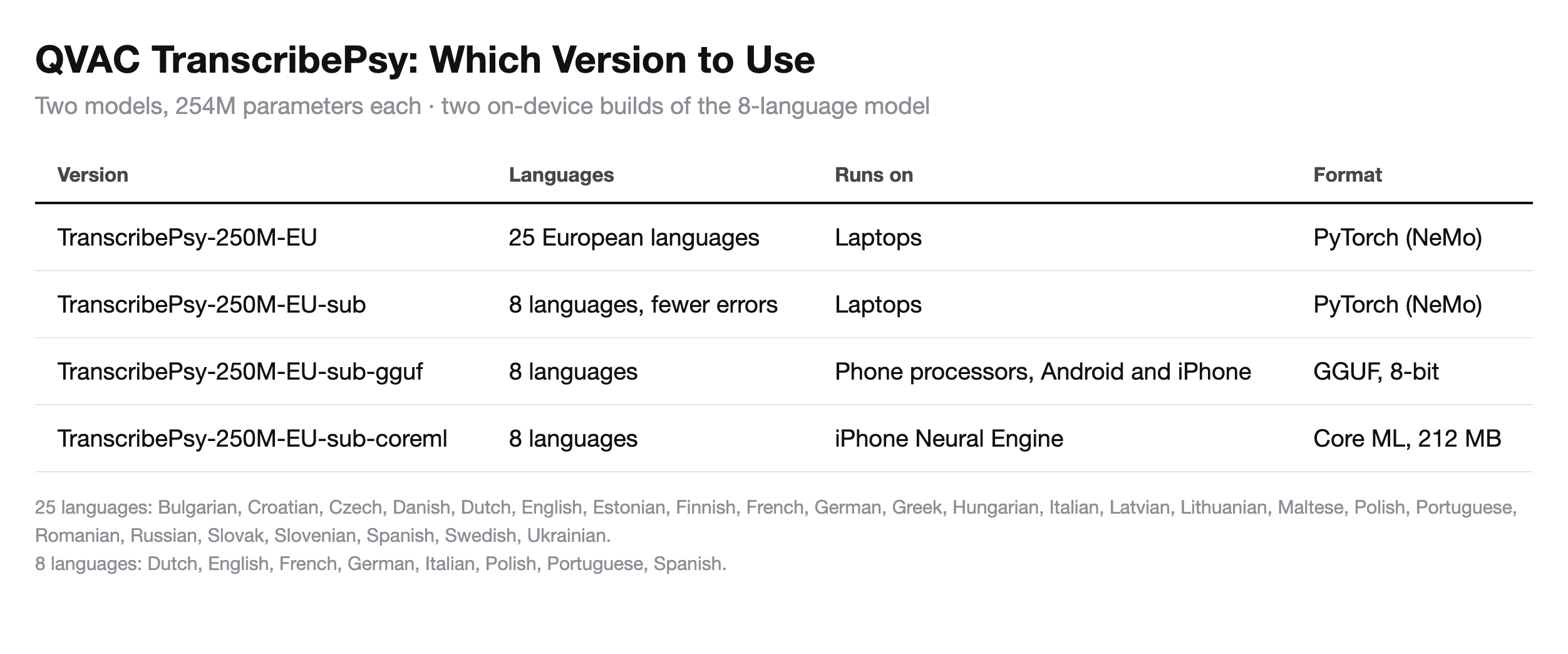
TranscribePsy comes as two models and two on-device builds.
The 25-language model handles English with its main weights and adds a small adapter for its other 24 languages. When you do not know which language is coming, a built-in language gate picks it for each utterance, at a cost of about 0.1% word error rate on English.
How was it built?
TranscribePsy is a 254M-parameter FastConformer-TDT model. It started as NVIDIA's Parakeet-TDT-0.6B-v3, a 627M-parameter model, which we cut down by structured pruning and then used the original as the teacher: the smaller model learned to reproduce the larger one's outputs. It trained on about 564,000 hours of speech across the 25 languages.
Starting from a pruned copy of the teacher instead of from scratch means the small model keeps much of what the teacher already learned, which is why 254M parameters are enough. Learning from the teacher rather than from transcripts alone passes its behavior on to the languages with the least training data.
What comes next?
We are working on smaller and faster models, on support for more languages, and on streaming, so the text appears while you speak. A full technical report with the per-language results will follow.
How does TranscribePsy fit with the other Psy models?
TranscribePsy is the voice layer of the QVAC Psy models. We are building toward Psy models that work together on the device and without a connection: ask aloud about what the camera sees and VisionPsy answers, TranslatePsy puts a conversation into your language, and MedPsy takes a health question.
Yes. The weights are open under Apache 2.0 and released for research and educational purposes, together with the evaluation configs. The training code and data are not part of this release.
No. Once downloaded, it runs on the phone or laptop itself, so the audio never leaves the device. Phones run the 8-language model; laptops can run either.
The 25-language model covers Bulgarian, Croatian, Czech, Danish, Dutch, English, Estonian, Finnish, French, German, Greek, Hungarian, Italian, Latvian, Lithuanian, Maltese, Polish, Portuguese, Romanian, Russian, Slovak, Slovenian, Spanish, Swedish and Ukrainian. The 8-language model covers Dutch, English, French, German, Italian, Polish, Portuguese and Spanish, with fewer errors.
Not yet. This release transcribes each recording or utterance once it is complete. Streaming is in progress.
The full-precision models load with NVIDIA's NeMo toolkit and take 16 kHz mono audio. On phones, use the GGUF build that supports 8 European languages on the processor or the Core ML build on the iPhone Neural Engine, both through the qvac-transcribepsy engine. For the best performance and fastest inference speeds, we recommend using the qvac-fabric-speech.cpp parakeet engine. It is optimized for efficient execution and delivers the highest performance among the available runtime options.
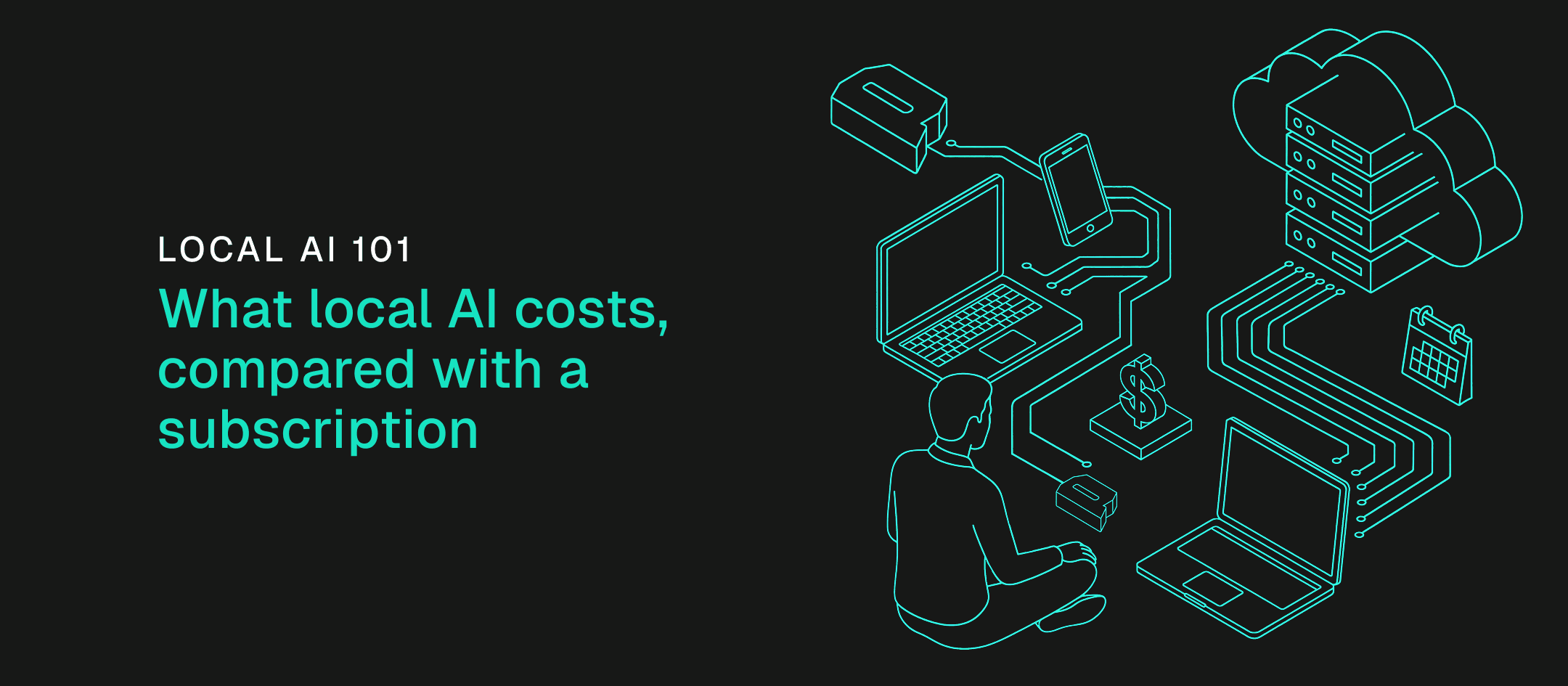
We priced four usage profiles by the tokens they burn each month to find when your own machine costs less than an API or a subscription, and which machine each profile needs.
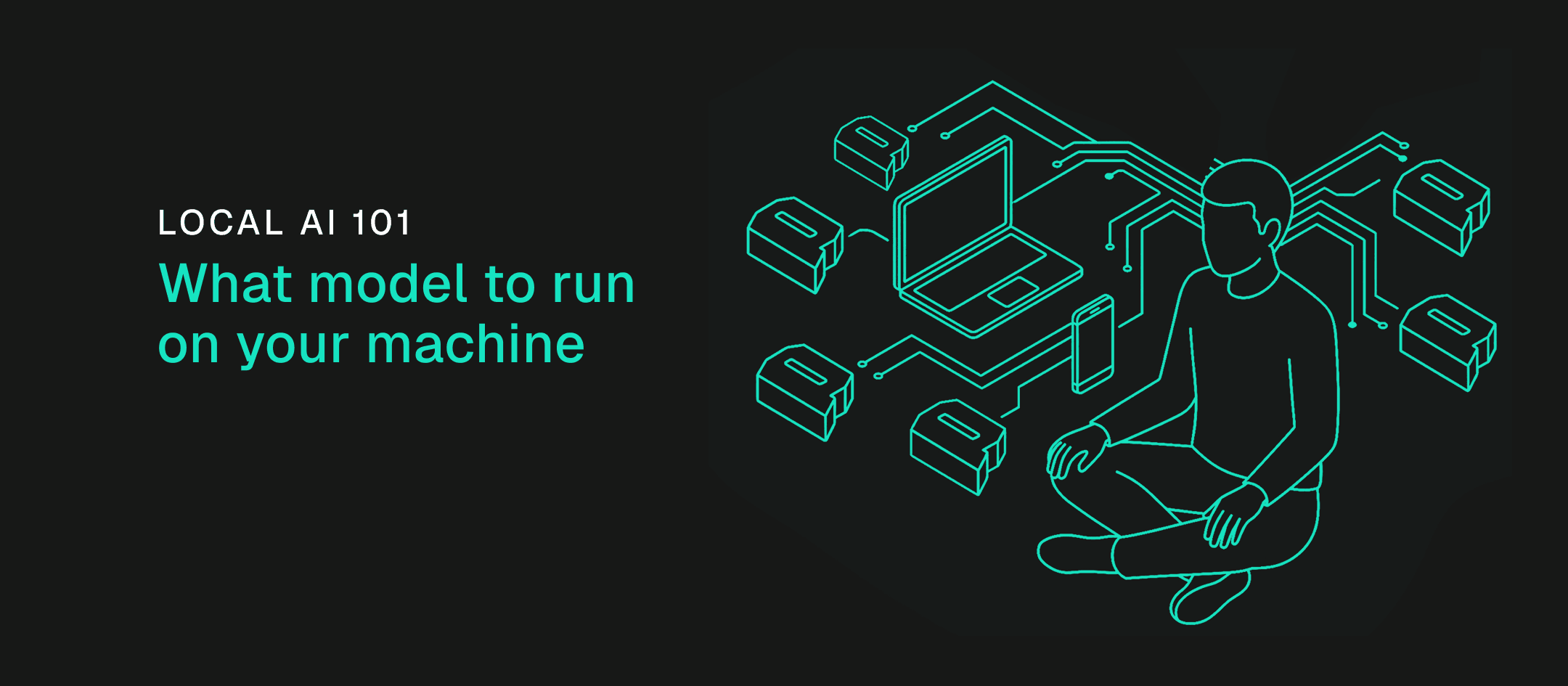
A phone or an 8 GB laptop handles most everyday AI jobs, and video needs 32 GB. How much memory local AI needs, and the command that tells you what yours has.
We built Genesis III to push small models as far as they can go on STEM. A 1.7B model trained on it answers more than twice as many questions correctly as the same model trained on the open alternative, from an identical token budget.
We priced four usage profiles by the tokens they burn each month to find when your own machine costs less than an API or a subscription, and which machine each profile needs.
A phone or an 8 GB laptop handles most everyday AI jobs, and video needs 32 GB. How much memory local AI needs, and the command that tells you what yours has.
We built Genesis III to push small models as far as they can go on STEM. A 1.7B model trained on it answers more than twice as many questions correctly as the same model trained on the open alternative, from an identical token budget.