QVAC is the fastest engine for audio on your own device
Our engineering team has been optimising the QVAC audio stack, so we measured it. We put qvac-fabric-speech.cpp against the open-source engines people run for transcription, speech synthesis and music generation, on four machines and six GPU lanes, timing every engine from outside its own process so that nobody's own stopwatch is quoted. QVAC leads on the GPU lanes we measured, across every vendor. Here is each number, and how we took it.
T
Thomas Blanc
Our engineering team is continuously optimising the QVAC audio stack.
The optimisations live in qvac-fabric-speech.cpp, the open-source engine underneath it, and we benchmarked its three main capabilities: transcription, speech synthesis and music generation.
github.com/tetherto/qvac-fabric-speech.cpp
We compared them on four machines and six GPU lanes, against the open-source engines people run for each job. Here are the results.
Transcription
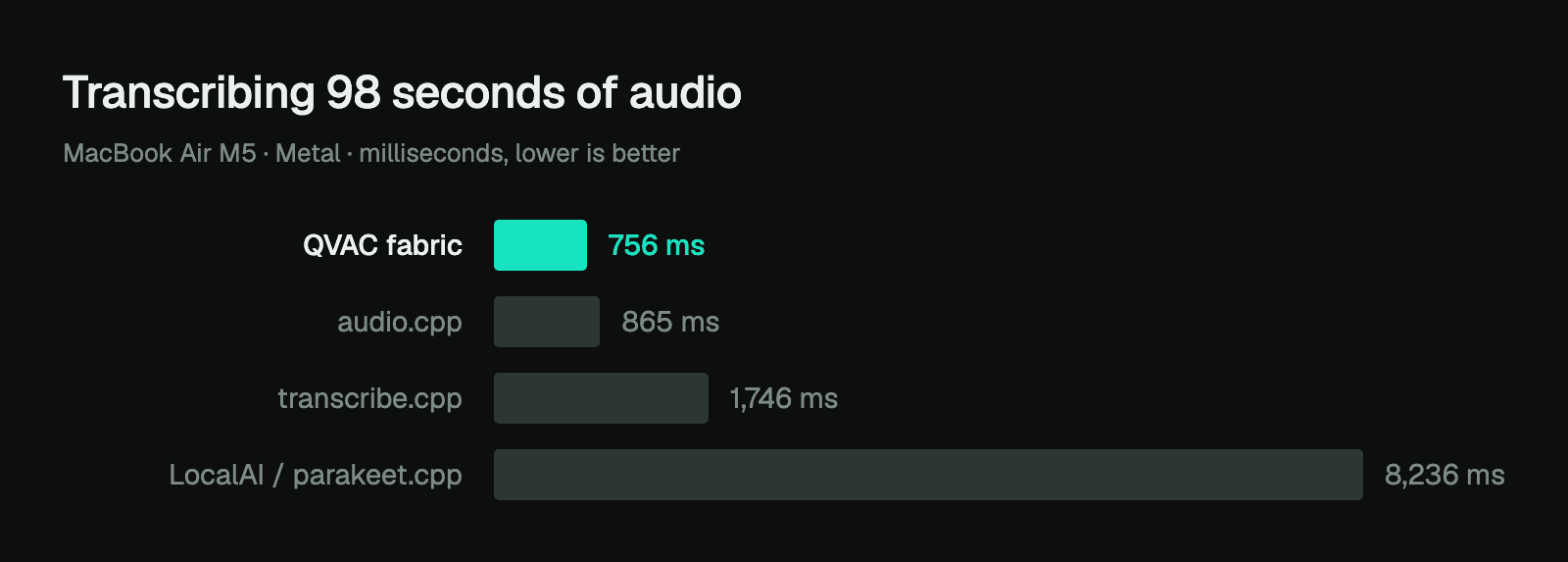
We transcribed a 98-second clip with Parakeet TDT 0.6b v3.
On a fanless MacBook Air it takes us 756 ms and audio.cpp 865 ms. That machine has no fan and its results swing 7 to 24 percent between runs, so we read those two as level. transcribe.cpp takes 1,746 ms on the same laptop. parakeet.cpp, the engine LocalAI ships for this model, has no working Metal path at the commit LocalAI pins, and takes 8.2 s.
QVAC is fastest on long audio transcription. Similar result for short audio.
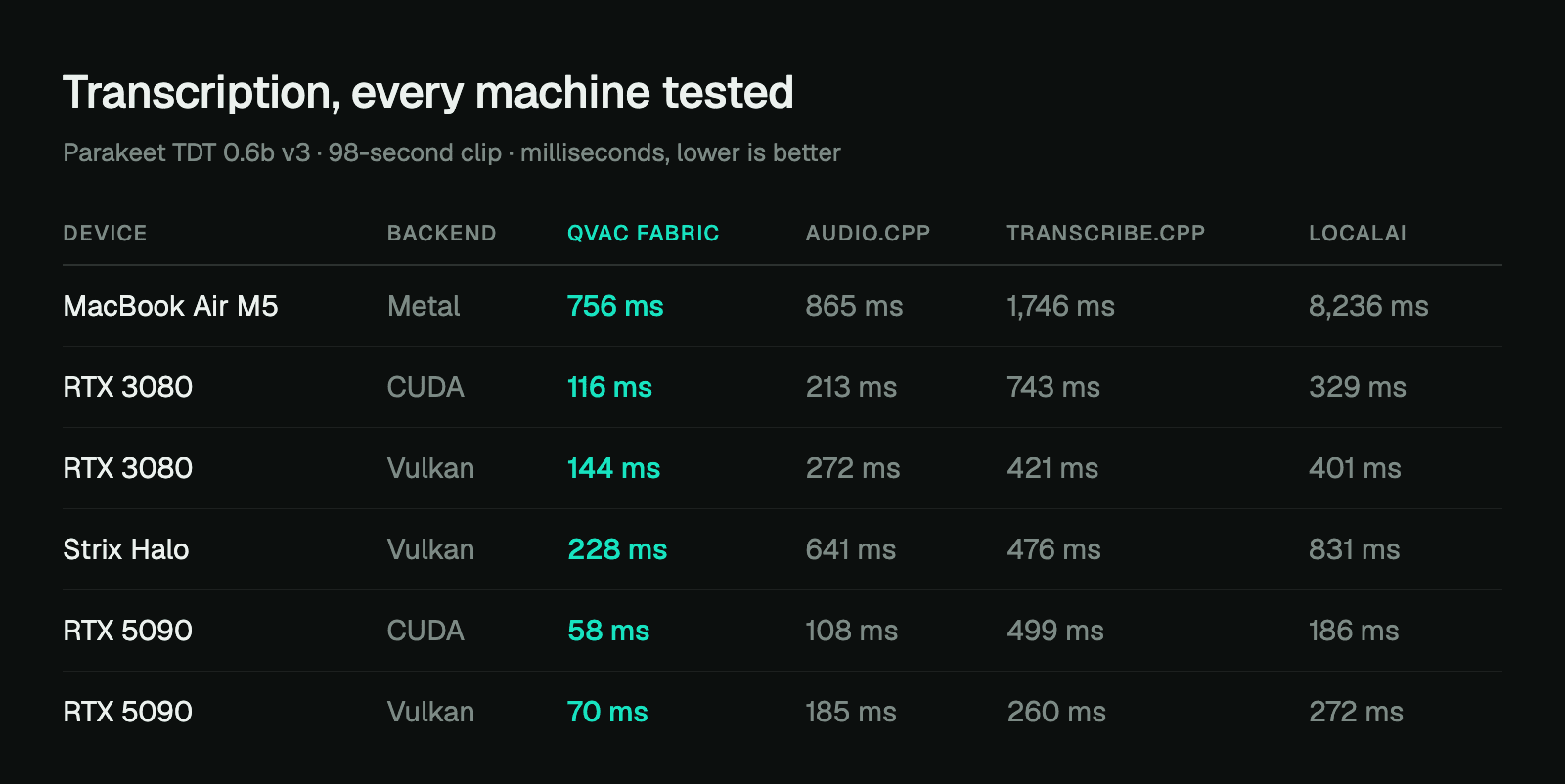
The gap opens up on the other five GPU lanes, where Fabric leads audio.cpp by 1.85x to 2.81x. It leads transcribe.cpp on all six, by 2.1x to 8.5x. On an RTX 5090 over CUDA the clip takes 58 ms.
The same clip across all six GPU.
Speech synthesis
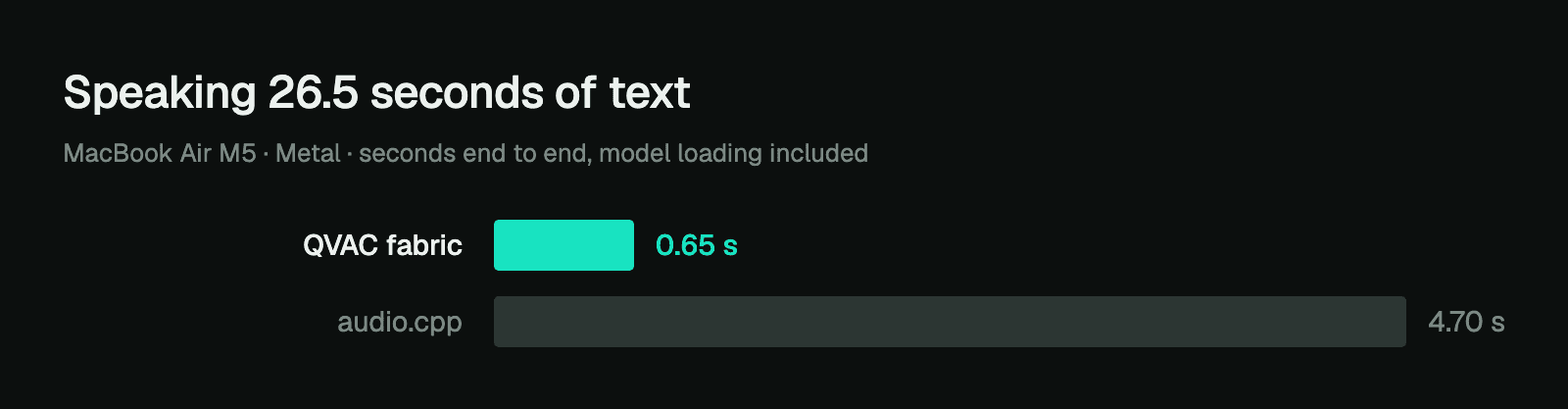
Supertonic 3 speaks 26.5 seconds of text in 0.65 s on that MacBook Air, against 4.70 s for audio.cpp.
QVAC is fastest here, mostly because the model loads in 0.66 s against 3.15 s.
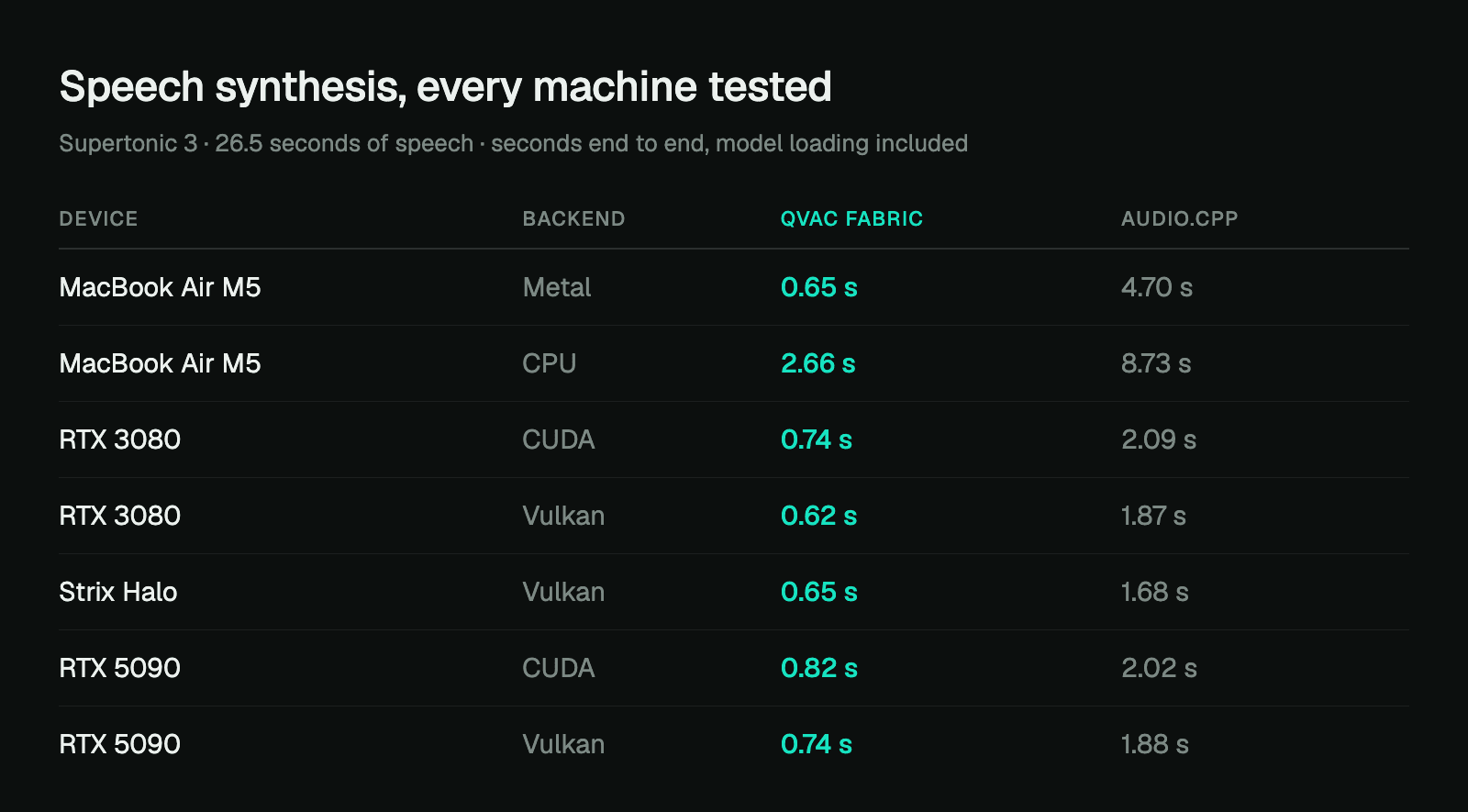
Fabric finishes synthesis first on Metal, CUDA and Vulkan, 2.4x to 7.2x faster end to end than audio.cpp, and loads its model 2.3x to 4.8x faster.
Synthesis on every machine, model loading included.
Music generation
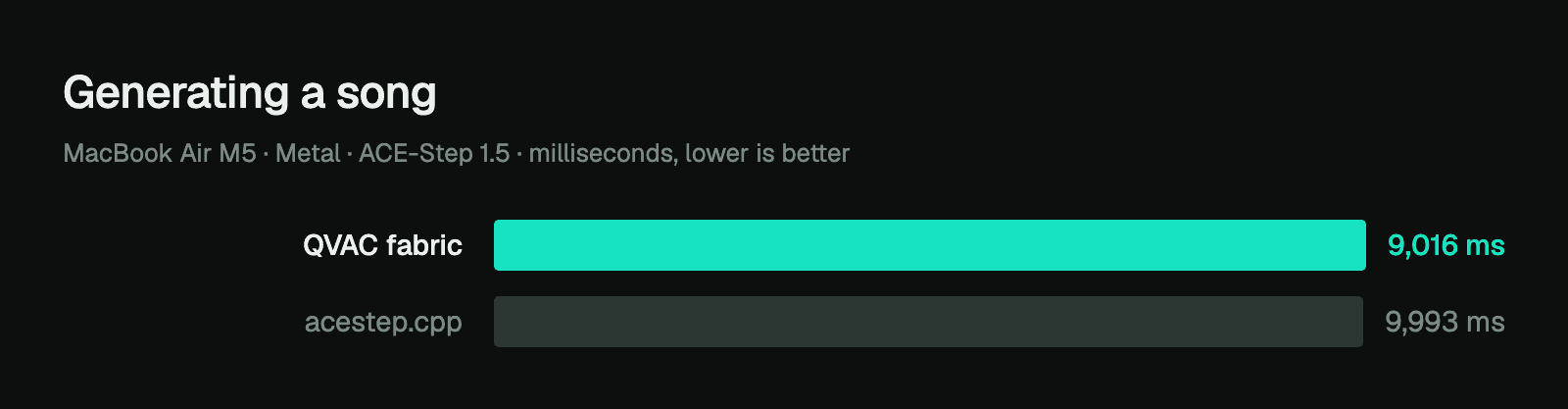
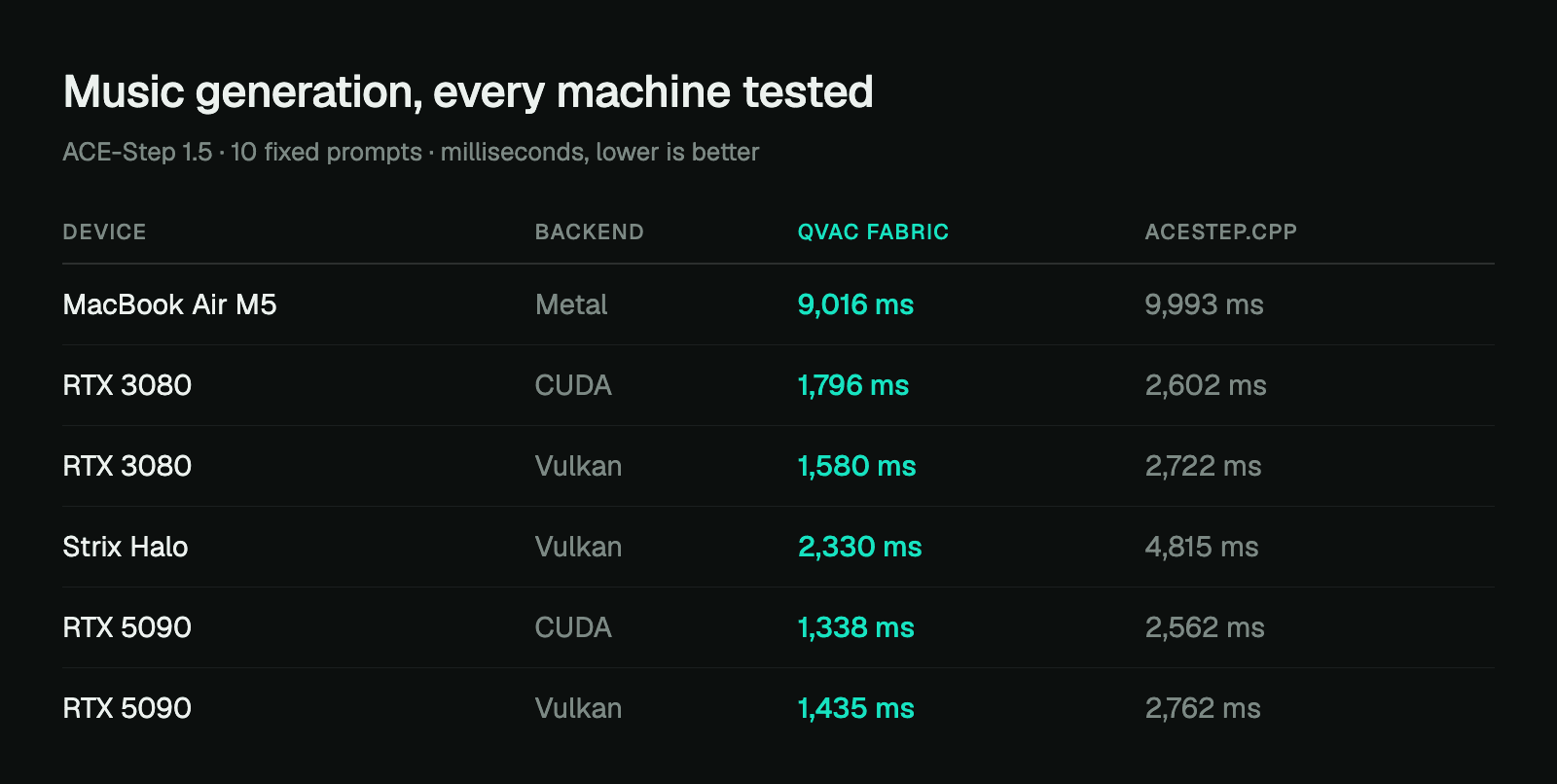
Generating a song takes us 9.0 s on the MacBook against 10.0 s for acestep.cpp, and 9.7 s against 10.0 s once our model load is counted in.
One song on the MacBook, generation time only.
On a Strix Halo we generate the same song in 2.3 s against 4.8 s for acestep.cpp, and we come out faster on every one of the 60 prompt-and-lane combinations.
The same song across every machine.
How we measured
Transcription: the clip run once, then eleven times in the same process, and the difference taken, so the loading time drops out.
Speech synthesis: the whole process timed, model loading included.
Music generation: generation timed, both engines loading the same four GGUF files.
On transcription every engine ran at its own shipping defaults with its own weights. On synthesis both engines ran at f16, the only precision their two packages share. We quote no engine's own timer, including our own.
Versions tested: audio.cpp 0.7.3, transcribe.cpp 0.2.3, parakeet.cpp at the commit LocalAI pins, acestep.cpp at upstream HEAD. We forced acestep.cpp's release build, since its own script leaves the build type unset.
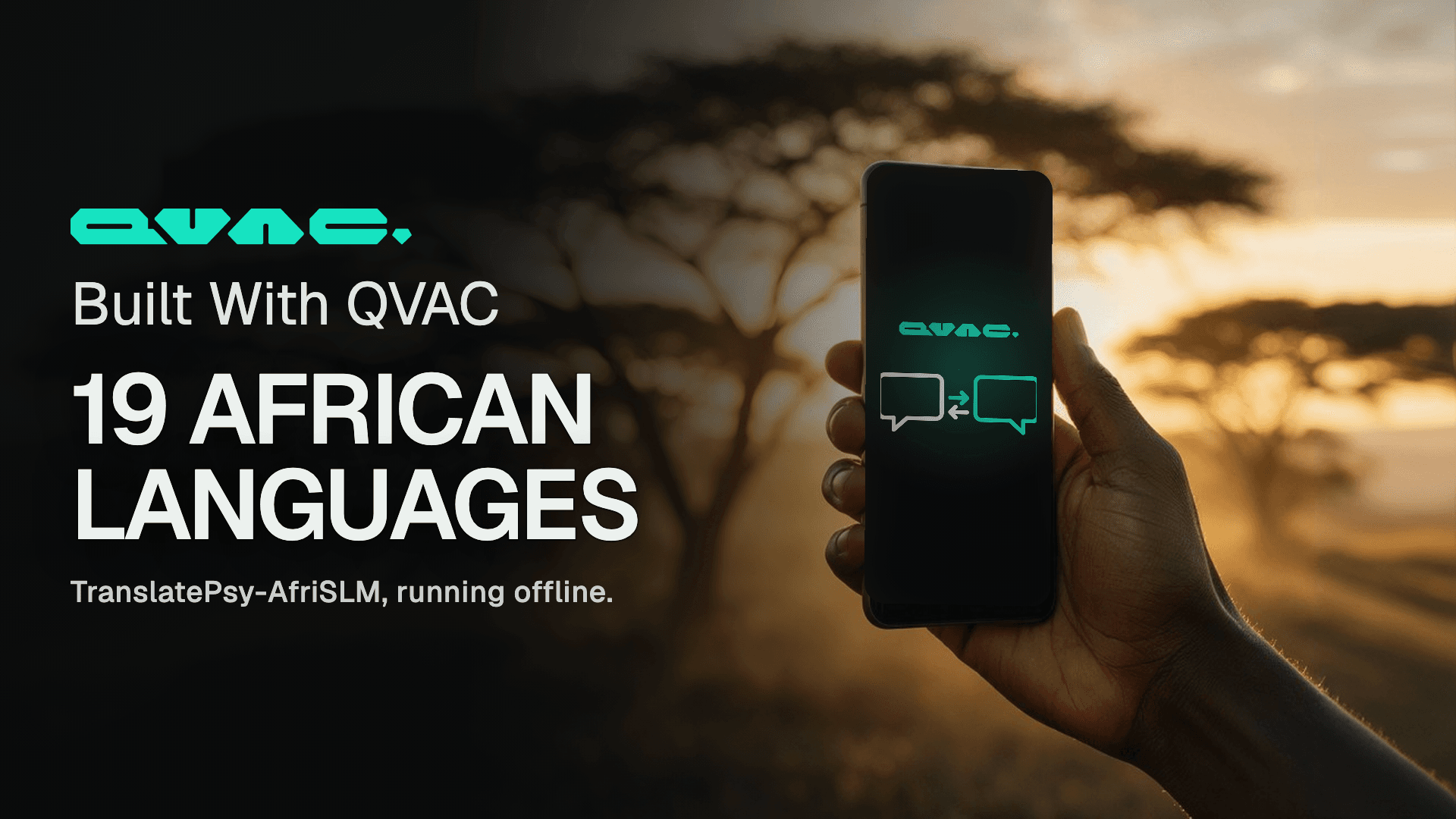
TranslatePsy-AfriSLM is our translation model for 19 African languages, small enough to run on a phone. We built a demo on it: paste text or photograph a page, and read it in your language, with no connection and nothing to pay.
Running AI on your own machine raises two questions at once: which models your laptop can actually run, and which model to use for which task. This first part answers the second one, job by job, across chat, documents, speech, translation, images and video. Every model listed runs through QVAC, the free and open-source toolkit we build for local AI, on laptops and on phones, with nothing leaving your device.
Searching your own documents with AI means comparing your question against every vector you have stored, and that gets slow and memory-hungry as the collection grows. TurboVec is a vector index that makes the search faster and the stored vectors much smaller, with no training step over your data. It is available in the QVAC SDK, and the RAG code you already write does not change.
TranslatePsy-AfriSLM is our translation model for 19 African languages, small enough to run on a phone. We built a demo on it: paste text or photograph a page, and read it in your language, with no connection and nothing to pay.
Running AI on your own machine raises two questions at once: which models your laptop can actually run, and which model to use for which task. This first part answers the second one, job by job, across chat, documents, speech, translation, images and video. Every model listed runs through QVAC, the free and open-source toolkit we build for local AI, on laptops and on phones, with nothing leaving your device.
Searching your own documents with AI means comparing your question against every vector you have stored, and that gets slow and memory-hungry as the collection grows. TurboVec is a vector index that makes the search faster and the stored vectors much smaller, with no training step over your data. It is available in the QVAC SDK, and the RAG code you already write does not change.