
TranscribePsy: on-device speech recognition in 25 European languages
TranscribePsy is a 254M-parameter speech recognition model that turns speech into text on a phone or a laptop, in 25 European languages on a laptop and 8 on a phone.
Read More
QVAC SDK 0.12.0, shipping June 1 2026, integrates TurboQuant, a KV-cache quantization algorithm published by Google Research at ICLR 2026. The result: on-device LLMs can now hold up to 5x more context with the same model, on the same device, with nearly no measurable accuracy loss. No code changes. No retraining.
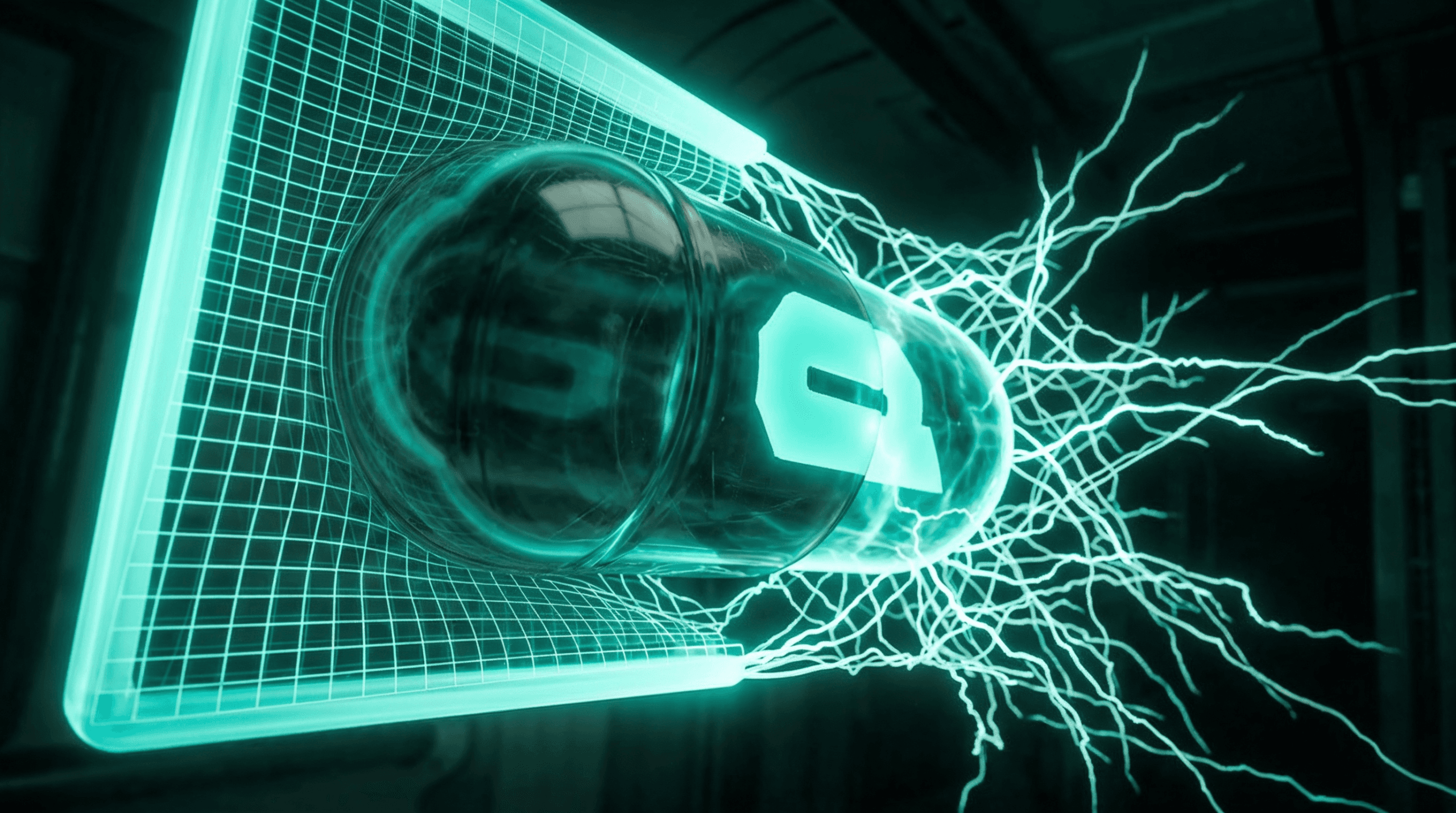
If you have ever pasted a long document into a local AI app and watched the model stop mid-page with "context limit exceeded", you have hit the memory ceiling that has shaped local AI for years. The model wasn't the bottleneck. The memory aka Key-Value cache was.
QVAC SDK 0.12.0 changes that.
The KV cache is the working memory an LLM keeps during a conversation. Every token of your prompt, every previous assistant turn, every attached document is stored as Key-Value pairs on-device. This cache lets the model maintain coherence across long contexts without reprocessing everything from scratch on each token.
The trade-off: the cache grows linearly with context length and model depth. A Qwen3.5-4B at 262K tokens stores roughly 8 GB of KV data in 16-bit precision. That is twice the size of the Q8 weights themselves. The KV cache, not the model, is what blows past your VRAM.
Local AI has two memory walls. First, the model weights have to fit on your device: too big and you can't run it at all. Once they fit, the KV cache becomes the second wall: it caps how much context you can hold. TurboQuant attacks the second wall.
TurboQuant compresses the KV cache from 16 bits down to roughly 3 bits per value while preserving accuracy across long-context benchmarks. The practical effect:
GPU | VRAM | KV budget | Context before 0.12.0 | With TurboQuant |
|---|---|---|---|---|
RTX 5060 | 8 GB | 3.7 GB | ~120K tokens | 262K tokens (full) |
RTX 5070 | 12 GB | 7.7 GB | ~250K tokens | 262K tokens (full) |
RTX 5090 | 32 GB | 27.7 GB | ~262K tokens (already full) | 262K tokens |
AMD Ryzen AI Max+ 395 / Strix Halo | 128 GB | 123.7 GB | ~262K tokens (already full) | 262K tokens |
Estimates assume a 4B model at Q8 quantization. Real ceilings depend on the model size and other memory consumers on the device.
Note: These figures do not account for the computation buffer (temporary tensors allocated during inference), so they are approximate estimates.
The table above shows how all hardwares benefit from Turboquant:
What this unlocks in practice:
Update to SDK 0.12.0:
npm install @qvac/sdk@latestTo enable TurboQuant on any model you load, pass the turboquant flag in your parameters. That is it.
Currently, TurboQuant is supported only for AMD & NVIDIA GPUs, support for iOS, Android & Apple Silicon coming next.
The context ceiling has, in practice, been an access ceiling. If you could afford a cloud API, you had no KV cache problem. Server farms have effectively unlimited memory. Long context was a feature you bought.
If you wanted to run AI on a device you actually own, where your data stays local, you hit the wall.
TurboQuant narrows that gap. The same model files you already use gain six times more memory headroom on the device you already own. More devices become capable of running real workloads. More people get direct access to intelligence that lives on their own hardware, not in a data center they will never see.
TurboQuant is a KV-cache quantization algorithm published by Google Research at ICLR 2026 (Zandieh et al.). It reduces the running context memory of an LLM by up to 5x with no measurable accuracy loss across major long-context benchmarks.
No. The QVAC team validated TurboQuant across four long-context benchmarks (LongBench, ZeroSCROLLS, RULER, L-Eval, NIAH) with LLama, Qwen and Mistral models. Nearly no accuracy loss was reported across all five. More details here.
No. TurboQuant is data-oblivious. It works with any standard transformer loaded as GGUF in the QVAC SDK without retraining, calibration, or fine-tuning.
Opt-in. Pass the TurboQuant flag when you load the model. Without it, the default KV cache behavior is used.
No. It only compresses the KV cache during inference. Your GGUF file size is unchanged. The compression happens in memory at runtime.
Update the QVAC SDK:
npm install @qvac/sdk@latestWant the technical breakdown of how TurboQuant works at the algorithm level? Read here
Sources
TranscribePsy is a 254M-parameter speech recognition model that turns speech into text on a phone or a laptop, in 25 European languages on a laptop and 8 on a phone.
Read More
We priced four usage profiles by the tokens they burn each month to find when your own machine costs less than an API or a subscription, and which machine each profile needs.
Read More
A phone or an 8 GB laptop handles most everyday AI jobs, and video needs 32 GB. How much memory local AI needs, and the command that tells you what yours has.
Read MoreTranscribePsy is a 254M-parameter speech recognition model that turns speech into text on a phone or a laptop, in 25 European languages on a laptop and 8 on a phone.
Read MoreWe priced four usage profiles by the tokens they burn each month to find when your own machine costs less than an API or a subscription, and which machine each profile needs.
Read MoreA phone or an 8 GB laptop handles most everyday AI jobs, and video needs 32 GB. How much memory local AI needs, and the command that tells you what yours has.
Read MoreStay updated
New versions, breaking changes and migration notes - straight to your inbox. No spam, unsubscribe anytime.